PHOTO: Abzas Media illustration
1/ KEY FINDINGS
In Azerbaijan, 211 incidents of attacks/threats against professional media workers and editorial offices of both traditional and online publications were identified and analysed in the course of the study for 2025. Data for the study were collected using open-source content analysis in Azerbaijani and English. In addition, information about these attacks was obtained from the statements by journalists, bloggers, and lawyers providing legal assistance to them. A list of the main sources is provided in Annex 1.
- Physical attacks and threats to life, liberty, and health increased by 67% and were predominantly directed against journalists who were already in custody.
- Attacks via judicial and/or economic means remained the main method of pressure on media workers, increasing by 71% since 2024.
- Pressure against independent journalists and bloggers extended to those Azerbaijani journalists forced into exile. At least 14 exiled journalists and bloggers were sentenced in absentia to prison terms ranging from 6 to 16 years.
- The majority of recorded attacks were perpetrated by representatives of the authorities.
- At least 39 media workers are currently imprisoned in Azerbaijan.
2/ THE POLITICAL SITUATION AND THE MEDIA IN AZERBAIJAN
In 2025, the situation regarding human rights and fundamental freedoms in Azerbaijan continued to deteriorate. According to assessments published by both local and international human rights organisations, the number of political prisoners in the country reached almost 400. These individuals include political leaders and activists, leaders and members of non-governmental organisations, as well as journalists and bloggers. The ability for opposition political parties, independent civil society organisations, and independent media outlets to function, has been almost entirely eliminated.
According to Freedom House’s Freedom in the World 2025 report, Azerbaijan remains a “not free” country. The report concludes that fundamental rights – particularly political rights – are subject to severe and systematic restrictions. Media freedom remains under intense pressure, and freedom of expression faces extensive legal and practical limitations. Overall, the report indicates that Azerbaijan remains among the lowest-performing countries with regard to democratic governance and freedoms.
Freedom House’s Freedom on the Net 2025 report, which assesses online and digital freedoms, continues to categorise Azerbaijan as “not free,” with no improvement compared with the previous year. Azerbaijan’s score remained unchanged at 34 points. In contrast, other South Caucasus countries – Georgia (70 points) and Armenia (72 points) – are classified as “free”.
The latest report by Reporters Without Borders (RSF) indicates a further decline in media freedom and freedom of expression in Azerbaijan. In 2024, Azerbaijan ranked 164th out of 180 countries in the World Press Freedom Index. In 2025, the country fell further to 167th place. RSF classifies Azerbaijan among countries facing “very serious” challenges. The report highlights the continued tightening of media legislation, which has made the operation of independent media outlets increasingly difficult. It also documents the imprisonment of dozens of journalists on fabricated charges, as well as persistent and serious shortcomings in media independence and journalists’ safety.
At least 39 media workers are currently imprisoned, all of whom were arrested on politically motivated and fabricated charges, primarily for criticising government policies or refusing to comply with restrictive and repressive regulations imposed by the authorities. Throughout the year, judicial proceedings against these journalists continued. Only one journalist was released, Aziz Orujov, editor-in-chief of the online channel Kanal13, who had been sentenced on charges of “illegal construction” and served his two-year prison term in full.
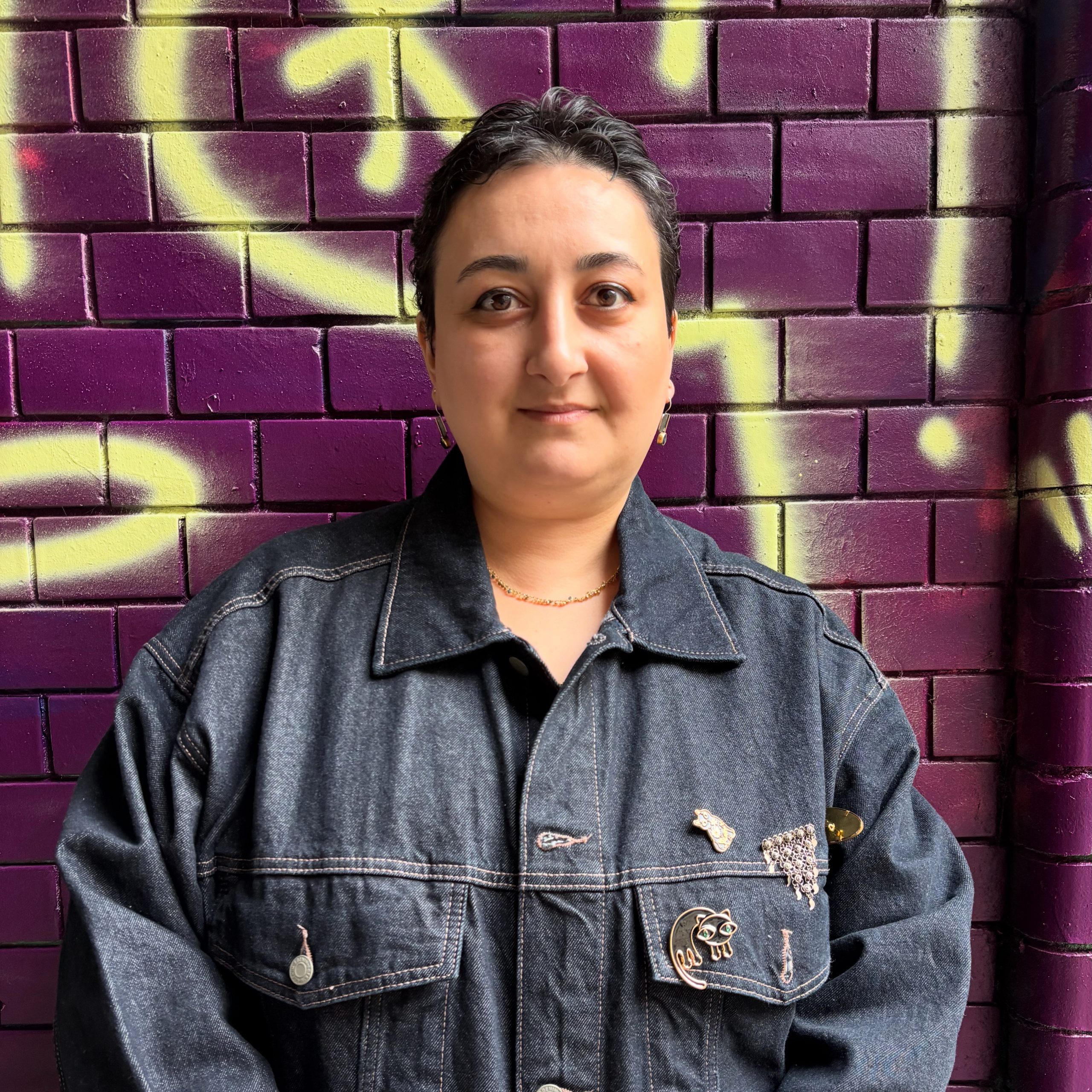
“The year 2025 marked the complete death of independent media and freedom of expression in Azerbaijan. The crackdown that began in November 2023 continued: independent media outlets were shut down throughout 2023–2024, and in 2025 the arrests expanded to target individuals. Freelance journalists and even ordinary citizens expressing opinions on social media were detained. Travel bans and financial restrictions remained in place, targeting activists, journalists, and the relatives of detained political prisoners. Abzas Media journalists were sentenced to prison terms ranging from 7.6 to 9 years. Many journalists were forced to “put down their pens”, because the alternative was persecution. those who escaped arrest were driven into exile and remain under threat of transnational repression. This was clear evidence that the idea of total control in the country had become reality. The authorities succeeded in creating a climate of fear and his fear was then legalized, with new laws expanding the mechanisms of punishment. But do you know what is most striking? The voice of independent media in Azerbaijan has not been silenced. Imprisoned journalists have turned prisons into newsrooms. Persecution, arrests, and fear- nothing has been able to suffocate the free voice. “
Gunel Safarova, Acting Director and Editor-in-chief, Abzas Media
According to announcements published on the “electronic court” system, the activities of more than 30 online media outlets were shut down within a one-year period. In February 2025, the independent news agency Turan announced the suspension of its operations amid a wave of arrests of independent journalists. The agency’s management cited financial constraints as the reason for the decision. Turan had been operating since 1990 and was widely regarded as one of the primary sources of information about Azerbaijan for international audiences. The rest of the shut-down media outlets declined to provide detailed public information regarding the circumstances of their closure.
3/ GENERAL ANALYSIS OF ATTACKS
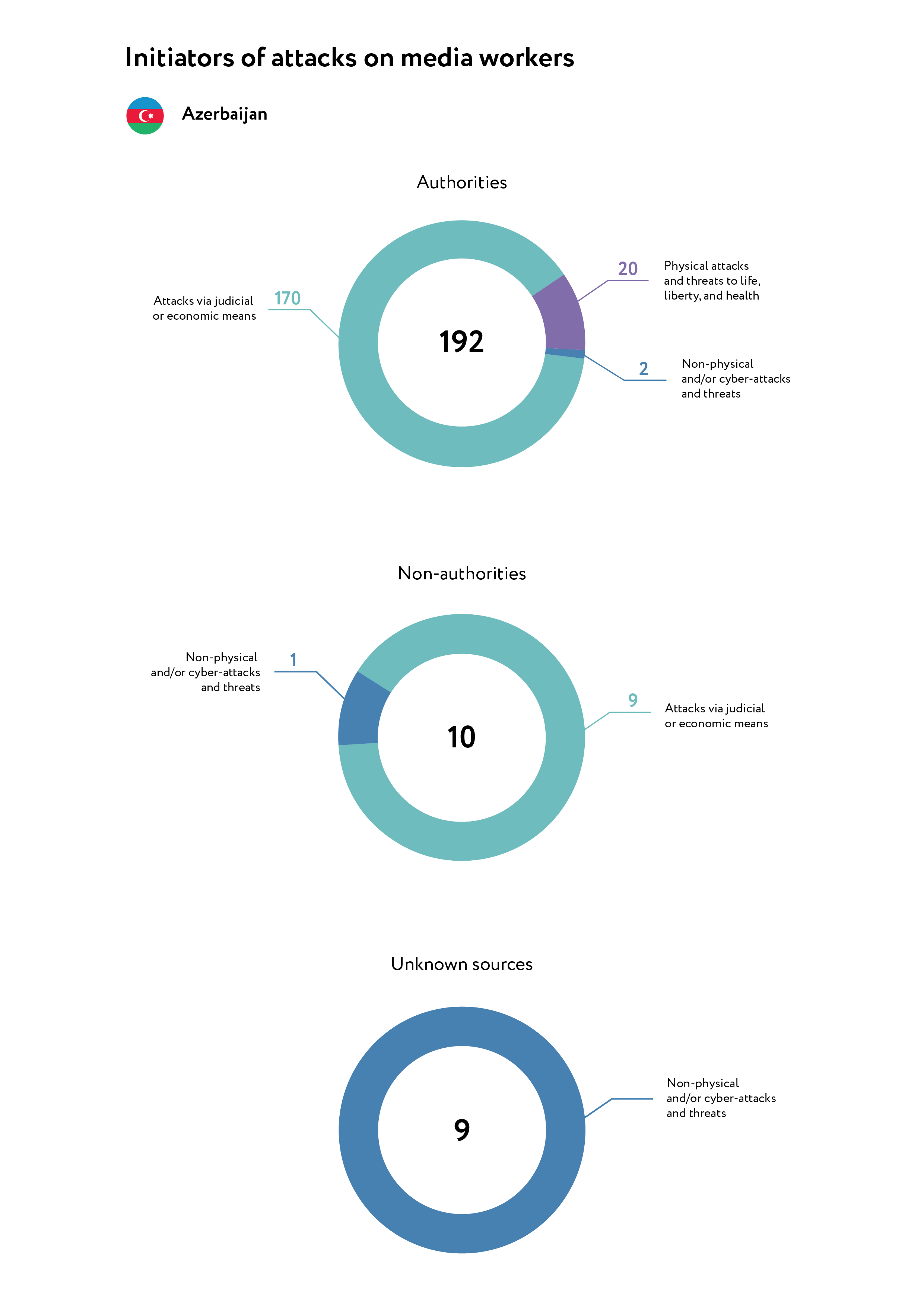
In 2025, 211 attacks against journalists, bloggers, and other media workers were documented in Azerbaijan. This figure matches the number recorded in 2021. At least 90% of these attacks were perpetrated by representatives of state authorities.
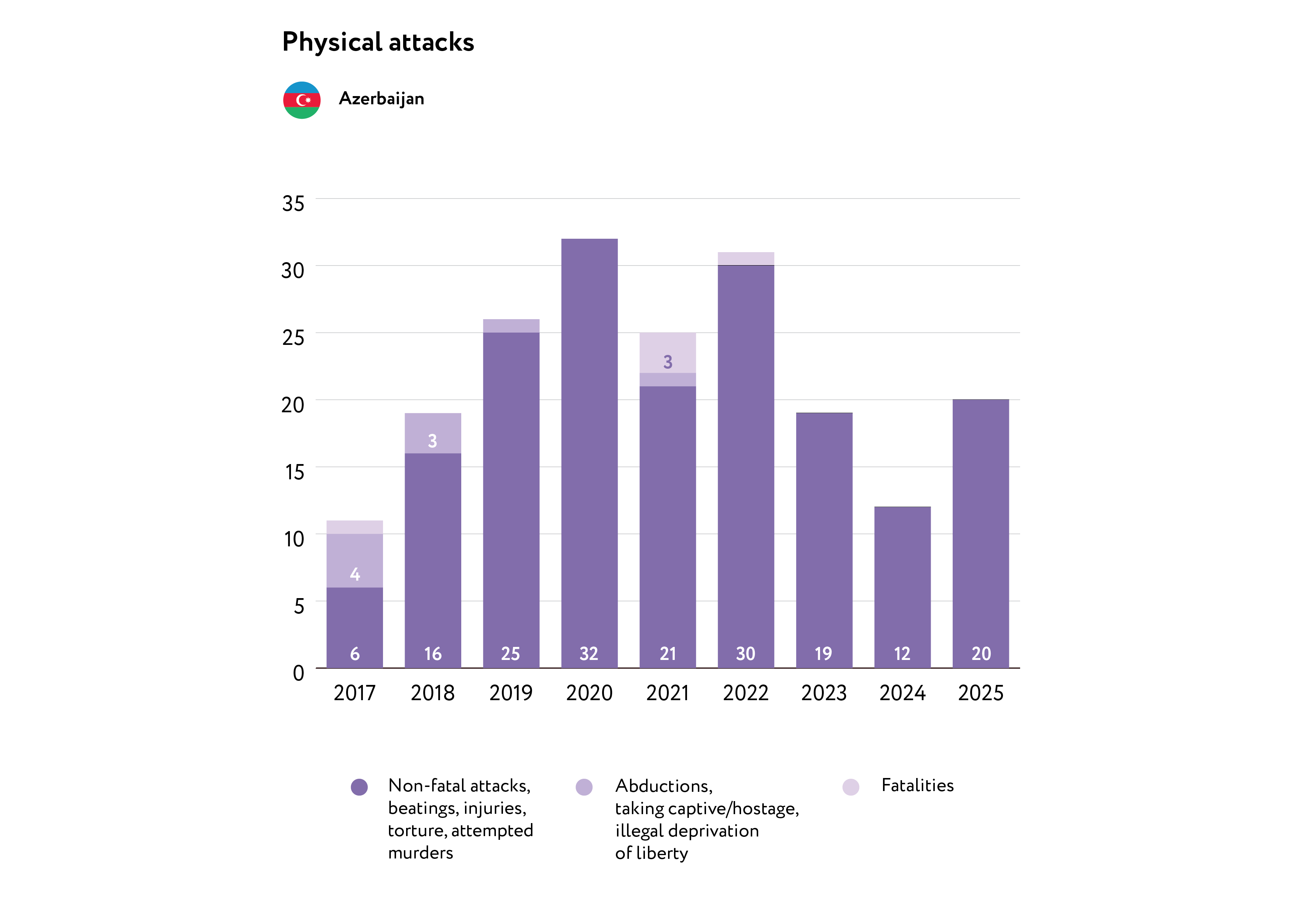
Compared with the previous year, the number of physical attacks and threats to life, liberty, and health increased by 67%. All recorded incidents in this category were carried out by state authorities and were predominantly directed at journalists who were already in custody.
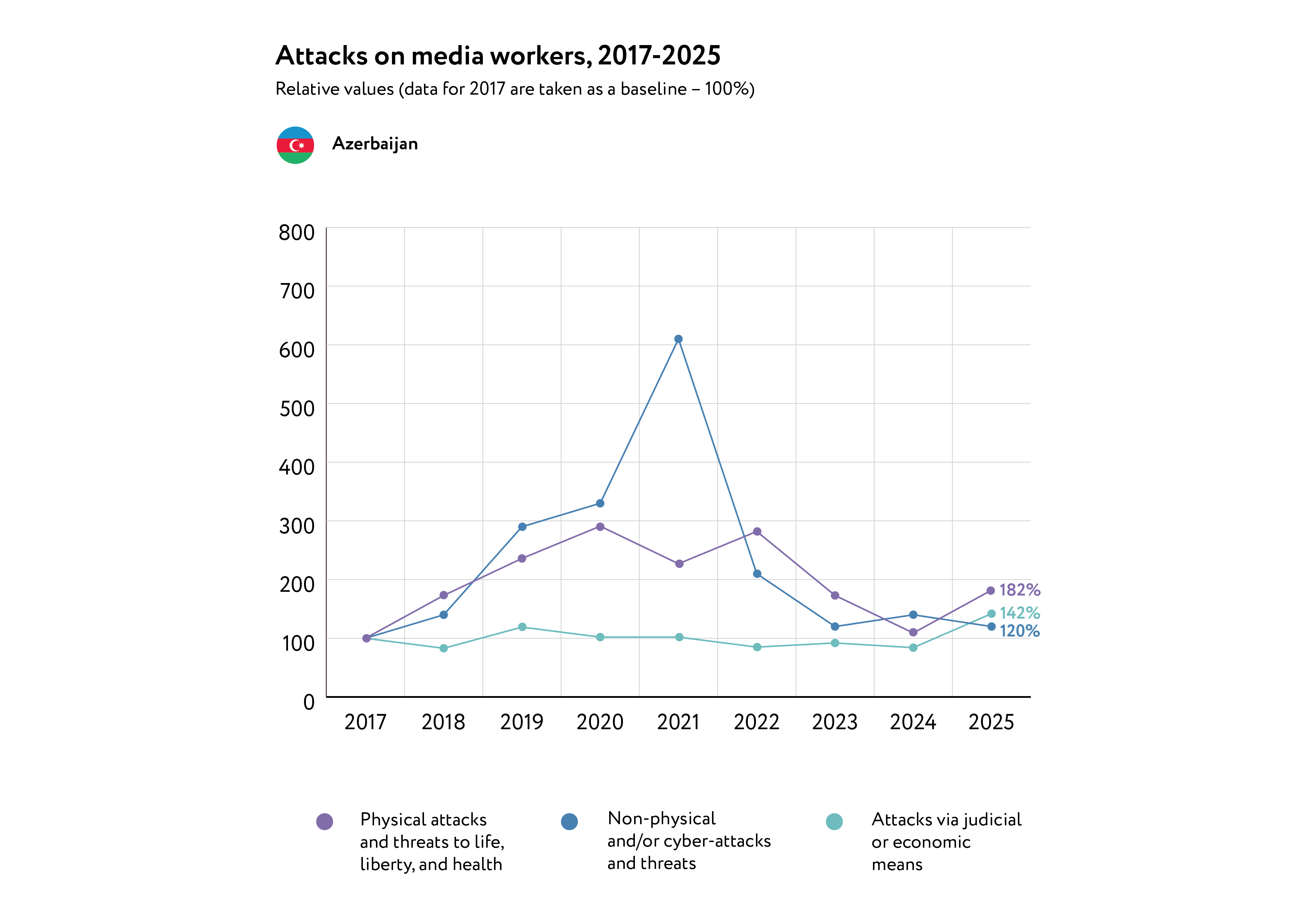
As in previous years, judicial and economic pressure remained the primary methods used to target media workers. In comparison with 2024, the number of attacks of this type increased by 71%. This increase is largely attributable to two factors: multiple criminal charges being brought against journalists in the Toplum TV and Meydan TV cases where each prosecuted journalist is facing up to seven charges; and the intensified pressure on journalists and bloggers working and living in exile.
4/ PHYSICAL ATTACKS AND THREATS TO LIFE, LIBERTY AND HEALTH
In 2025, at least 20 cases of physical violence against media workers were recorded in Azerbaijan. This figure represents a significant increase compared with the previous year, when 12 incidents were recorded. In 2024, journalists were primarily subjected to physical interference while they were carrying out their professional duties. In contrast, in 2025, physical violence was predominantly directed against critical journalists who were already in custody. These were mostly carried out by law enforcement and penitentiary staff.
Some examples of these incidents include:
- On 25 January, Sevinc Vaqifgizi, an editor at Abzas Media, was subjected to physical abuse by female officers while being held in a pre-trial detention centre. The journalist was physically assaulted and verbally humiliated. The incident occurred after she complained of discriminatory treatment compared with other detainees.
- On 29 January, blogger Rashad Ramazanov was subjected to physical violence for protesting against his inhumane detention conditions. Ramazanov’s family reported that he continues to be psychologically abused.
- On 4 February, Abzas Media journalist Nargiz Absalamova was assaulted by prison guards, when she attempted to greet a fellow journalist being held in detention. She was dragged along the floor, injuring her arm.
- On 12 August, Abzas Media journalist Mahammad Kekalov was subjected to pressure by prison officials. He was prohibited from making phone calls to lawyers. When he eventually attempted to contact his legal representatives, he was subjected to physical violence.
The police have also used force during the detention of media workers. Notable incidents include:
- On 7 May, Ahmad Mammadli, head of the YoldashMedia YouTube channel, was assaulted by police officers and subsequently arrested. During the incident, police demanded that he disclose his phone password. After refusing, he was tortured using an electric shock device and was later beaten by police officers.
- On the same day, Ulviyya Ali (Guliyeva), a contributor to Voice of America, was subjected to similar treatment. Police officers forcibly entered the journalist’s apartment and struck her in the head. She was later subjected to physical and psychological abuse at the police station, including physical assault and threats of sexual violence. Several days later, Ulviyya Ali was transferred to a pre-trial detention facility, where her abuse and ill-treatment reportedly continued.
Throughout 2025, at least four imprisoned journalists experienced serious health problems:
- Alasgar Mammadli, the detained founder of Toplum TV, developed tumours in various parts of his body. Despite the urgent need for medical intervention, authorities reportedly refused to provide adequate medical treatment.
- Farid Ismayilov, an employee of Toplum TV, also experienced recurring health problems while in prison. Shortly before his arrest, Ismayilov had undergone multiple surgical procedures and continues to suffer from severe breathing difficulties. Reports stated that authorities denied him access to essential medical care.
- Polad Aslanov, the imprisoned founder and editor-in-chief of xeberman.com, developed a number of serious health complications, including lung-related conditions. In protest against the failure of authorities to provide necessary medical treatment, Aslanov went on hunger strike, as a result of which he was reportedly subjected to physical and psychological abuse and threats.
- Imran Aliyev, the detained head of meclis.info, reported serious health concerns. The journalist suffers from severe back and joint pain and has developed tumours in various parts of his body. Relatives reported that he has not been given adequate medical assistance.
5/ NON-PHYSICAL AND/OR CYBER-ATTACKS AND THREATS
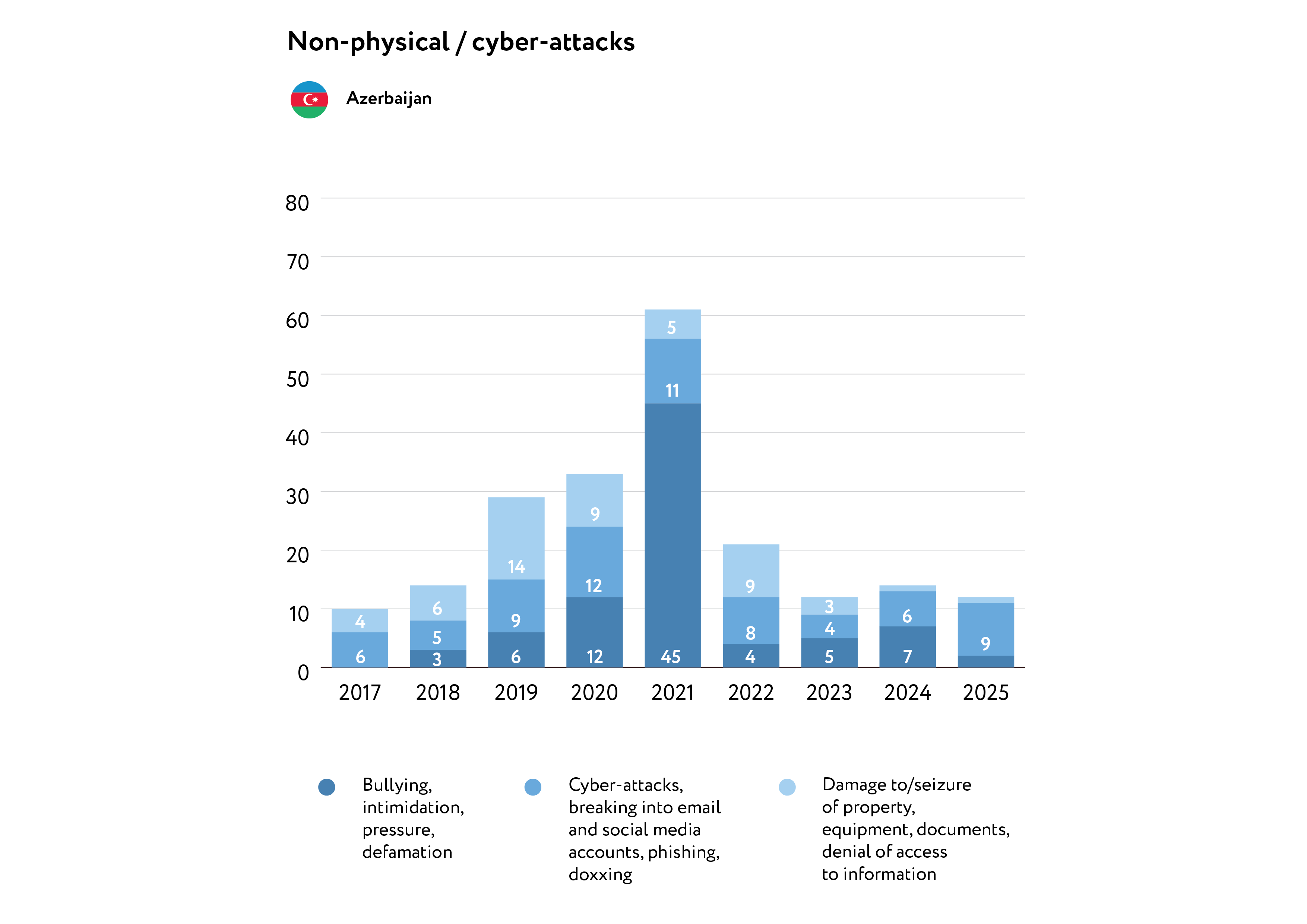
In 2025, 12 cases of non-physical attacks, including cyber-attacks and threats, were documented. Nine incidents involved DDoS and hacking attacks.
- On 20 February, the online platforms of several major media outlets were subjected to a coordinated cyber-attack. Websites, reportedly affiliated with the Global Media Group, including Report.Az, Oxu.Az, Media.Az, Baku.ws, Caliber.Az, and Baku TV, were hacked, rendering them inaccessible for an extended period. There were reports of unauthorised access to servers and administrative control panels for these sites. At the same time, the website of Public Television (ITV) was also hacked.
- On 22 December, the news portal qafqazinfo.az and its associated social media accounts were subjected to cyber-attacks. The outlet’s Instagram account was disabled, and its content was deleted. The account had been one of the most widely followed news pages in Azerbaijan.
Other recorded non-physical attacks include:
- On 20 January, independent journalist Nurlan Gahramanli was threatened by police officers at a polling station. He was prevented from collecting information related to the electoral process and ordered to leave the premises.
- On 26 April, Ali Zeynal, a journalist detained in connection with the Toplum TV criminal case, was threatened while in prison. He was warned not to publicise the unlawful practices occurring in the prison and was told that there would be “consequences” if he did not comply. When he refused, the journalist was placed in a so-called “punishment cell.”
5/ ATTACKS VIA JUDICIAL AND/OR ECONOMIC MEANS
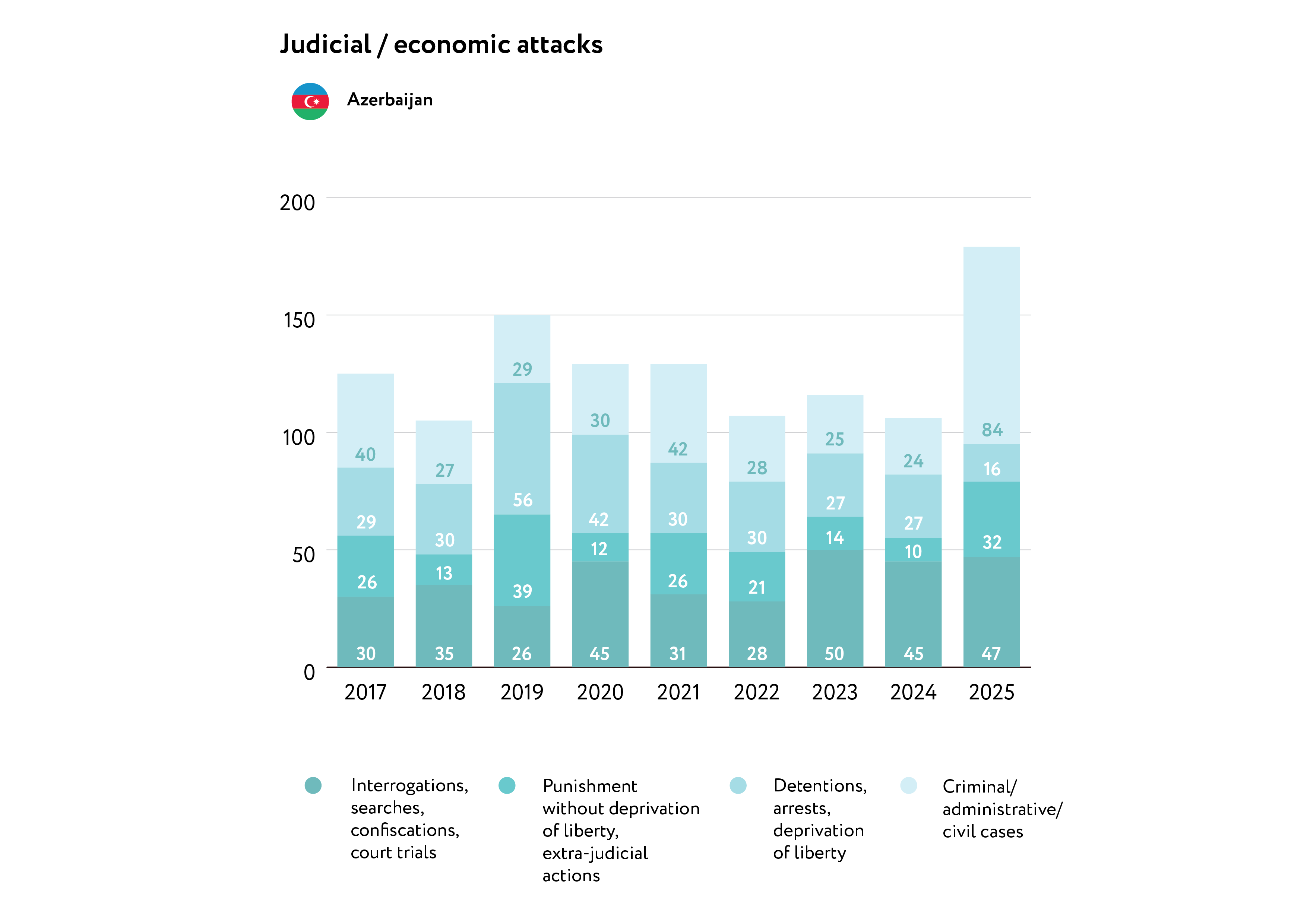
In 2025, the activities of at least 30 media outlets were terminated via court decision. These cases were brought by the Media Development Agency, the state body responsible for overseeing the implementation of the Law on Media. The agency claimed that the media outlets in question had failed to register with the Media Register as required by law and were therefore operating illegally. Domestic courts granted all of the agency’s claims. Detailed information about these cases was not published by local media. Only limited and incomplete data appeared in the electronic court system, indicating that at least 30 lawsuits seeking the “termination of media activity” had been filed and granted, without specifying which media outlets were affected. Among the media outlets whose activities were terminated by court order, only anaxeber.info, bizimxeber.az, and reportyor.info publicly provided detailed explanations.
In February, several foreign media outlets were forced to terminate their activities in Azerbaijan. BBC News announced the closure of its Azerbaijan bureau following a verbal demand from the Ministry of Foreign Affairs. The Azerbaijani authorities subsequently revoked the accreditation of Voice of America and Bloomberg. All of the aforementioned media organisations closed their offices in Baku.
The first months of 2025 were also marked by the arrest of several journalists on charges such as “smuggling”, “tax evasion,” and “illegal entrepreneurship.” These arrests are indirectly linked to new media legislation adopted in 2022, which prohibits media outlets from receiving foreign funding. The charges brought against the journalists were linked to alleged criminal offences, namely receiving grants from donor organisations and transferring these funds into the country.
Documented incidents included the following:
- On 17 January, independent journalist Farid Ismayilov was detained by police and placed in pre-trial detention as part of a criminal case opened against Toplum TV two years earlier. The journalist and his lawyers deny all charges.
- Following this incident, journalist Shahnaz Baylargizi was also placed in pre-trial detention for three months in connection with the Toplum TV case. A search was conducted at her home. On 26 February, Baylargizi was placed under house arrest.
- On 5 February, Shamshad Aghayev, head of the Argument.az portal, was arrested in connection with the criminal case against Meydan TV. His home was searched, and various items were confiscated. He was charged under Article 206.3.2 of the Criminal Code (“smuggling committed by a group of persons acting in prior conspiracy”). On 28 August, the charges in the Meydan TV case were changed, and seven additional articles were added against those arrested in this case.
- On 20 February, Nurlan Gahramanli (Libre), founder of Portağal Media, was detained as part of the Meydan TV case. A search was conducted at the journalist’s apartment in Sumgait, after which he was placed in pre-trial detention. Several days later, another journalist connected to the Meydan TV case, Fatima Movlamli, was arrested.
While several media workers are still awaiting sentencing in pre-trial detention centres, several journalists and bloggers have already been handed lengthy sentences:
- On 26 February, Aziz Orujov, the head of the online television channel Kanal 13, who had been held in custody since 2023, was sentenced to two years in prison. He was initially charged with “smuggling,” but the court found him guilty of “illegal construction.” Orujov was released in November after serving his sentence.
- On 24 February, Matlab Bagirov, head of theSalamNews information agency, was convicted. The journalist, who had been held since 2023, was found guilty of “fictitious entrepreneurship” and “legalisation of property obtained through criminal means” and was sentenced to 12 years in prison.
- On 4 March, blogger Arzu Sayadoglu Mammadov, known for his sharp criticism of the government on YouTube, was sentenced to seven years in prison having been found guilty of “extortion”.
- On 25 July, a verdict was issued against Javid Shiraliyev, editor-in-chief of the 7gün newspaper, who had been in custody for almost two years. The court found him guilty of fraud and sentenced him to seven years in prison.
- In June, the trial of the detained Abzas Media journalists concluded. A court in Baku found the journalists guilty of “smuggling” and “legalisation of property obtained through criminal means.” By the court’s verdict, Ulvi Hasanli, Sevinc Vaqifgizi (Abbasova), Farid Mehralizada, and Hafiz Babali were sentenced to nine years in prison; Mahammad Kekalov to seven years and six months; and Nargiz Absalamova and Elnara Gasimova to eight years.
Throughout 2025, media workers were subjected to indirect forms of pressure. Elmir Sadiqov, the uncle of exiled critical blogger and head of the Azad Soz channel, Tural Sadiqli, was arrested in Azerbaijan on charges of “illegal possession of weapons.” The blogger stated that the purpose of the arrest was to silence him. Mustafa Hajibeyli, head of the press service for the opposition Musavat Party and editor-in-chief of the basta.info news portal, faced the risk of losing his home having been sued over a relative’s bank debt. He was threatened with the forced sale of his home by a court order.
In 2025, the pressure against independent journalists and bloggers extended to Azerbaijani journalists who had already been forced into exile. At least 14 exiled journalists and bloggers were arrested in absentia. The Prosecutor General’s Office opened criminal cases against exiled Azerbaijani bloggers, including: Tural Sadiqli, Ordukhan Teymurkhan (Babirov), Imadeddin Alimanov, Suleyman Suleymanli, Elshad Mammadov, Mahammad Mirzali, Rafael Piriyev, Gabil Mammadov, Orkhan Aghayev, Gurban Mammadov, Sevinc Osmanqizi, and Abid Gafarov, as well as Ganimat Zahid, editor-in-chief of Azadliq newspaper, and its employee Natiq Adilov. They were charged with offences including “fraud,” “public calls for terrorism,” “calls for mass riots and violence,” “calls for armed rebellion,” and “forgery of official documents.” Pre-trial detention orders were issued in absentia against all of them. Most court proceedings related to these cases have been completed. According to the court’s verdict, Imadeddin Alimanov, founder of the Xalq TV YouTube channel, was sentenced in absentia to seven years in prison; Gabil Mammadov to 16 years; Mahammad Mirzali to six years and six months; Ganimat Zahid to seven years; Elshad Mammadov and Tural Sadiqli to 14 years; and Gurban Mammadov, Suleyman Suleymanli, Orkhan Aghayev, Rafael Piriyev, and Ordukhan Teymurkhan to nine years.
In 2025, at least two journalists were subjected to travel bans:
- On 11 January, journalist Khanum Mustafayeva was prevented from leaving Azerbaijan without an explanation. Authorities at Baku airport cited a travel ban by the Ministry of Internal Affairs but gave no further details.
- On 10 November, the Azerbaijani government refused to extend the permanent residence permit of journalist Ruslan Suleymanov and imposed a one-year entry ban. Suleymanov, an ethnic Azerbaijani and citizen of Russia, has been living in Baku since 2022 and renews his residence and work permit in the country every year. He stated that Azerbaijani authorities informed him “at the very last moment” that his permit would not be extended this year.
ANNEX 1: OPEN SOURCES USED FOR GATHERING DATA (AZERBAIJAN)
- Abzas Media – an Azerbaijani non-profit independent media outlet;
- Azadlıq Radiosu – the Azerbaijani service of Radio Free Europe/Radio Liberty;
- Arqument.az – an Azerbaijani news site;
- Committee to Protect Journalists – an American independent, nonprofit, non-governmental organisation based in New York City, with correspondents around the world. CPJ promotes press freedom and defends the rights of journalists;
- Election Monitoring and Democracy Studies Center (EMDS) – a non-governmental organisation. Main goals — elections monitoring and the formation of democratic institutions in Azerbaijan;
- Freedom House – a non-profit organisation based in Washington, D.C. It is best known for political advocacy surrounding issues of democracy, political freedom, and human rights;
- Gözətçi – a news site of Azerbaijan. The website aims to collate information on human rights violations;
- Meydan TV – a weekly online television channel. Its mission is to inform active members of society about the state of affairs in politics, the economy, and social life; to offer a platform for open and diverse discussions on all topical questions concerning Azerbaijani society;
- Reporters Without Borders – an international non-profit and non-governmental organisation that safeguards the right to freedom of information;
- Turan – an independent news agency. The agency distributes news, analytical articles, and overviews from Azerbaijan;
- Toplum.TV – an Azerbaijani news site;
- Voice of America – a multimedia news organisation in the USA that produces content in over 45 of the world’s languages for audiences with limited access to a free press.