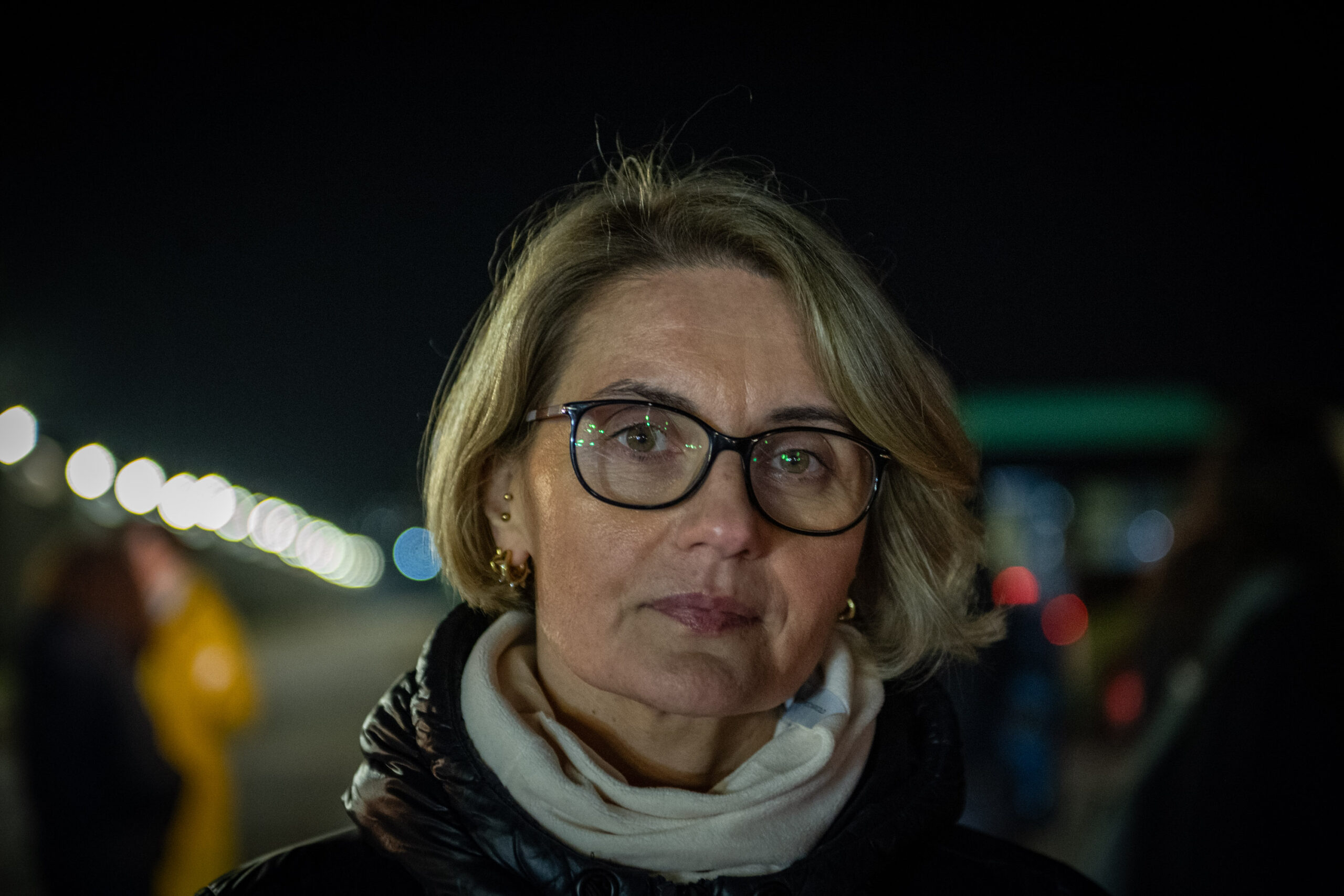
AUTHOR OF THE REPORT: MARIAM NIKURADZE, JOURNALIST AND CO-FOUNDER, OC MEDIA
PHOTO: MARIAM NIKURADZE, JOURNALIST AND CO-FOUNDER, OC MEDIA
1/ KEY FINDINGS
In Georgia, 250 cases of attacks/threats against professional media workers and editorial offices of both traditional and online publications were identified and analysed in the course of the study for 2025. This figure is consistent with 2024, when 298 incidents related to threats and abuse of media workers were recorded. Data for the study were collected using open-source content analysis in Georgian, English, and Russian. A list of the main sources is presented in Annex 1.
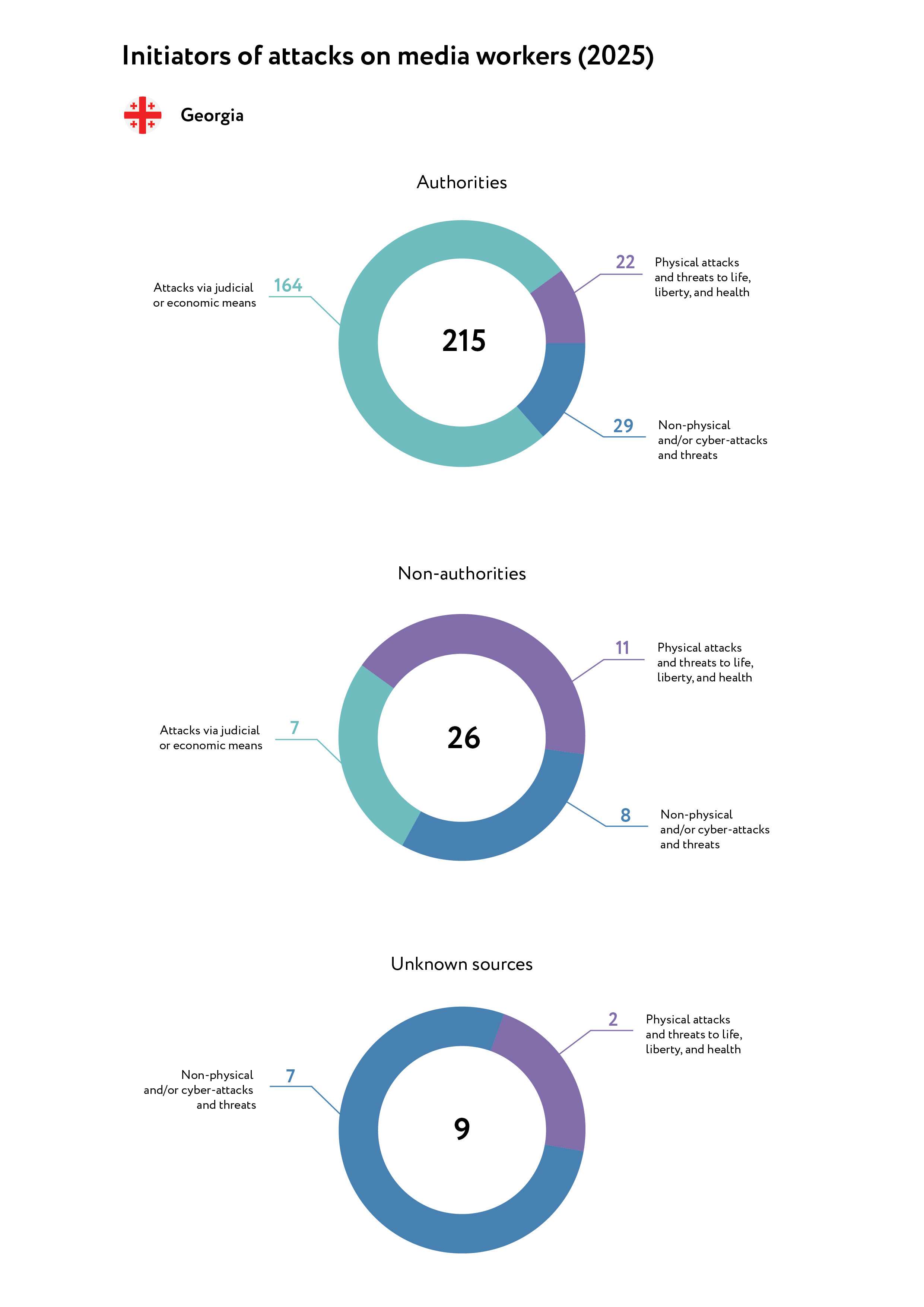
- 85% of attacks were perpetrated by representatives of the authorities.
- The number of physical and non-physical attacks decreased threefold compared with 2024.
- A total of 171 incidents, or 68% of all recorded attacks, were carried out via judicial and/or economic means, compared with 75 incidents in 2024.
- Media freedom continued to deteriorate, with the ruling Georgian Dream party adopting further laws and restrictions, including banning all recording inside and outside court buildings.
- Nine foreign journalists were denied entry into Georgia.
2/ THE POLITICAL SITUATION AND THE MEDIA IN GEORGIA
In 2025, Georgia fell 14 places – to 114th – in the World Press Index published by Reporters Without Borders (RSF). The state of media freedom continued to deteriorate: in 2024, Georgia fell 26 places, and in 2023, 29 places. “The media landscape is diverse and, at the same time, highly politically polarised. Manipulation, hate speech and disinformation are widespread in the media, especially on television, the main source of information,” the RSF report states.
According to Transparency International’s Georgia report, in 2025, 17 regional broadcasters ceased broadcasting due to financial difficulties, while two major opposition channels TV Pirveli and Formula TV are on the verge of shutting down. In May, Georgia’s opposition TV channel, Mtavari Arkhi, ceased broadcasting and switched to a social media-only presence, significantly reducing its reach. The channel cited financial and political pressure as the reason for this decision.
The ruling political party, Georgian Dream, continued adopting repressive laws threatening freedom of speech and assembly. From April, local NGOs receiving foreign funding were required to obtain approval from the government. After this regulation came into force, the authorities seized the bank accounts of several prominent NGOs, including ISFED, Social Justice Center, and IDFI. The Anti-Corruption Bureau also initiated investigations into several media organisations. However, no restrictions were ultimately imposed on these outlets, as the bureau was dissolved in November. Additionally, TV broadcasters were banned from receiving direct or indirect funding from “foreign powers.” The Communications Commission was granted the authority to request court approval to access bank and financial information relating to TV channels.
Parliament also adopted amendments to the defamation law, which now require the defendant to prove their innocence, rather than obliging accusers to prove guilt.
In the summer, new regulations came into force completely banning photo, video and audio recordings in courtrooms, court buildings and surrounding areas.
The government continued to exert pressure on street protests and further restricted freedom of assembly. “Artificially blocking the road” is now punishable by a fine of up to GEL 5,000 (approximately EUR 1,600). More than twenty journalists were fined for this offence while on duty covering protests, and several journalists received multiple fines. Towards the end of the year, penalties were further tightened: up to 15 days of detention for a first offence and up to one year of imprisonment for repeated violations. These provisions were later extended to protests on pavements as well. After the stricter regulations came into force, several journalists were arrested and served administrative detention.
“The severity of the media freedom crisis in Georgia is shaped by multifaceted and sustained attacks on independent media and individual journalists. However, if I were asked to identify a single case that captures this reality most clearly, it would undoubtedly be that of Mzia Amaglobeli. Her case offers a stark illustration of how the system treats critical media, individual journalists, independent thinkers, and, ultimately, ordinary citizens. The authorities have mobilised the full range of institutional tools at their disposal – law enforcement, the judiciary, political structures, financial pressure, and coordinated smear campaigns – to silence and deter critical voices.
At the same time, Mzia herself has come to symbolise the system’s deep fear of honesty, courage, and a steadfast commitment to freedom. Her case has also become a rallying point for Georgia’s independent media. Researchers have described this phenomenon as “Mzia’s Effect”: her personal sacrifice, unwavering courage, and resilience have broken fear, inspired solidarity, and collective resistance across independent newsrooms in the face of rising authoritarianism.”
Tamar Rukhadze, journalist and Deputy Director of Batumelebi
3/ GENERAL ANALYSIS OF ATTACKS
In 2025, a total of at least 250 attacks and threats against media workers were documented, representing a slight decline from 298 in 2024. Of these, 171, or 68% of all recorded attacks, were carried out via judicial and/or economic means. The majority of such cases involved administrative persecution and fines, court proceedings and other restrictions following alleged administrative offences.
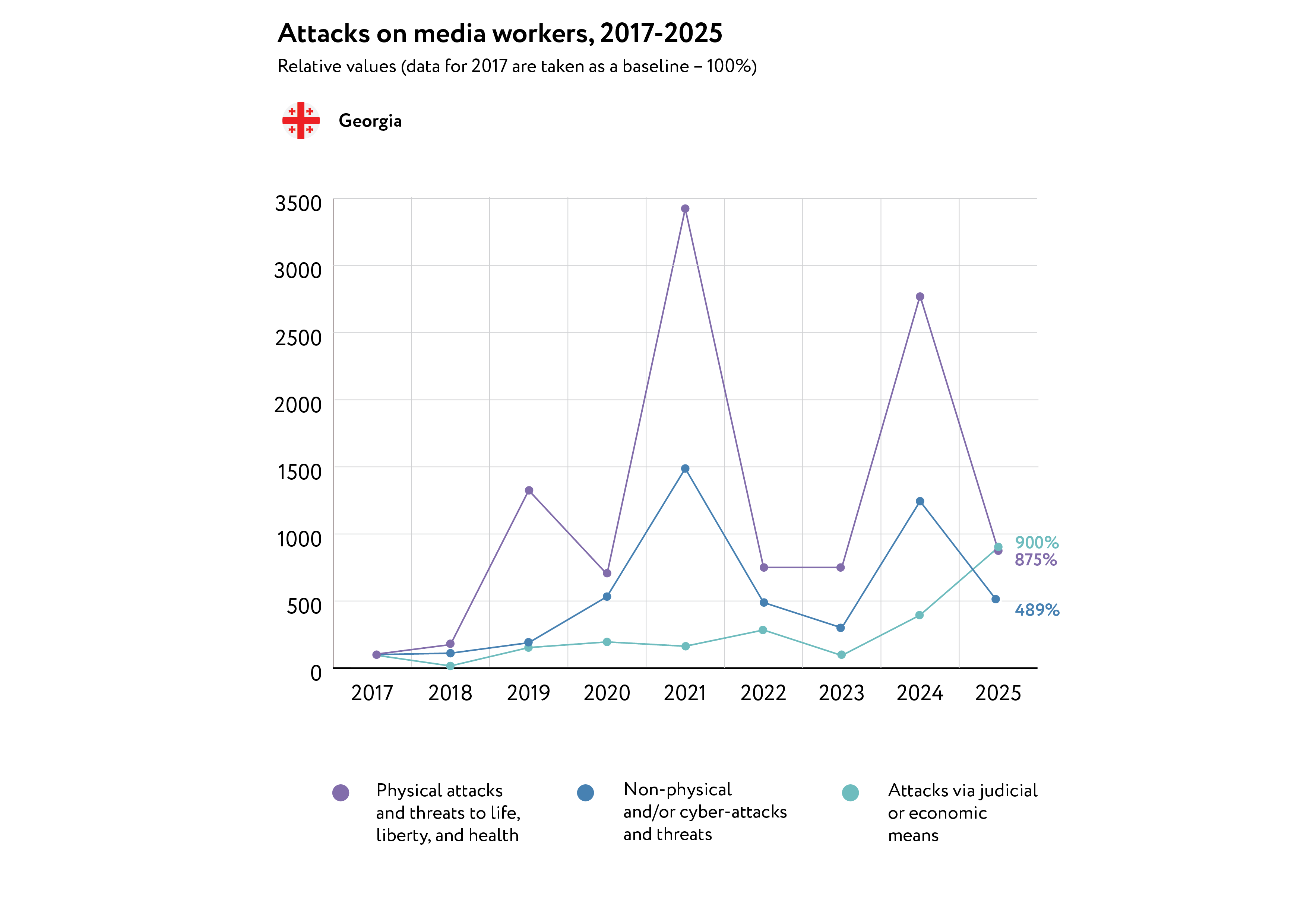
Over the course of the year, the ruling Georgian Dream party continued to introduce restrictions on freedom of expression and assembly that directly affected journalists. 40 journalists and photographers were fined for “artificially blocking the road” on Rustaveli Avenue, where daily anti-government protests took place. In total, 50 cases of administrative prosecution against journalists have been recorded in 2025, mostly for the same offence.
The number of cases involving the denial of entry to foreign journalists increased. Nine foreign journalists were denied entry into Georgia in 2025, compared with five in 2024. The actual number may be even higher as some journalists chose not to report the ban in the hope of appealing the decision and returning to Georgia at a later date.
4/ PHYSICAL ATTACKS AND THREATS TO LIFE, LIBERTY AND HEALTH
35 incidents of physical attacks and threats to life, liberty, and health were recorded – almost three times fewer than in 2024. All incidents were non-fatal. 22 of these cases were perpetrated by representatives of the authorities. The majority of the attacks occurred while journalists were covering anti-government protests, primarily on 2 February, 8 September, and 4 October.
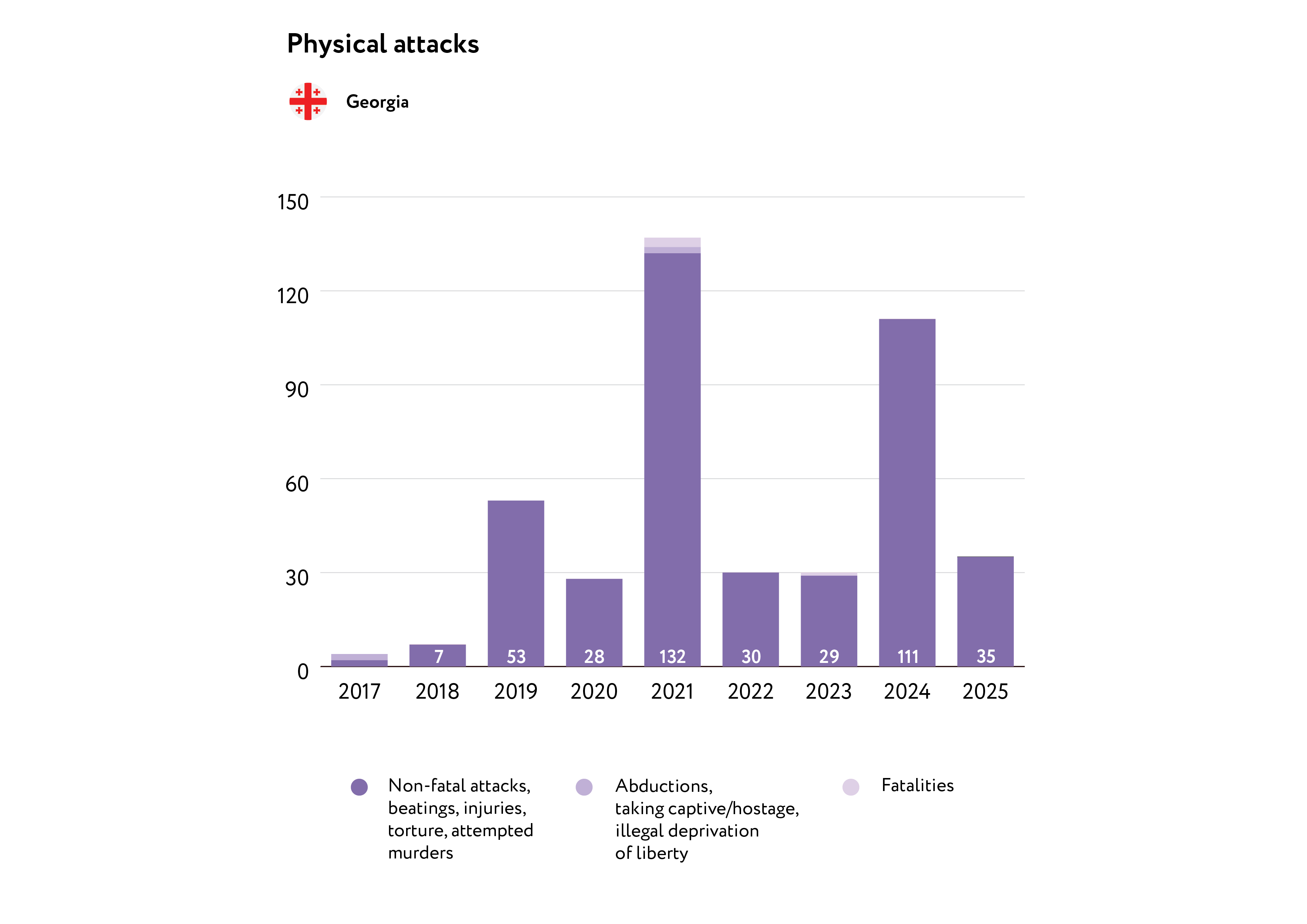
Cases of physical violence against journalists can be divided into two categories:
1) Attacks by Individuals Not Directly Connected to the Authorities: These include attacks by guards of private establishments or individuals ideologically aligned with the authorities:
- On 5 April, the leader of the political movement “United Neutral Georgia”, Vato Shakarashvili, and the film director and Georgian Dream propagandist Goga Khaindrava physically assaulted Giorgi Mamniashvili, a journalist for the opposition TV channel Mtavari TV.
- On 8 September, supporters of the ruling Georgian Dream party assaulted Hungarian journalist László Mézes outside the election headquarters of mayoral candidate Kakha Kaladze. Mézes was hospitalised with multiple injuries, including a broken finger and facial wounds requiring stitches. His phone was also taken during the attack. Publika journalist Ketevan Mikadze was also physically attacked, and her phone was confiscated. Although formal investigations were launched into these incidents, no one was held accountable.
2) Targeted Attacks by Police or Government Officials: These most often occurred during anti-government protests.
- On 2 February, during a live broadcast, police struck TV Pirveli journalist Diana Chirgadze while she was covering a protest in front of the Tbilisi Mall shopping centre. Officers also attempted to damage TV Pirveli’s equipment and insulted the crew.
- On 3 February, police shoved, struck, and pulled Publika photographer Natia Leverashvili by the hair while she was documenting police violence against protesters outside Parliament. The protesters were demanding the release of journalist Mzia Amaglobeli.
- On 23 May, Sulkhan Meskhidze, journalist and founder of Adjara Times, was covering a session of the Khelvachauri local municipality. Initially denied entry, he was later admitted, after which his questions angered local officials. He was struck several times and then forcibly removed from the building.
- On 4 October, riot police fired a tear gas canister during the dispersal of an anti-government protest on the election day, striking TV Pirveli journalist Irakli Bakhtadze, who was covering the event live. He was wearing a helmet, which protected him from injury. On the same day, police officers verbally and physically assaulted journalist Giorgi Diasamidze and damaged the phone he was using to film. Officers ignored Diasamidze’s press credentials and press vest.
5/ NON-PHYSICAL AND/OR CYBER-ATTACKS AND THREATS
In 2025, 44 incidents of non-physical and/or cyber-attacks and threats were recorded – almost three times fewer than in the previous year. Of these, 34 incidents involved damage to/seizure of property, equipment, documents as well as denial of access to information.
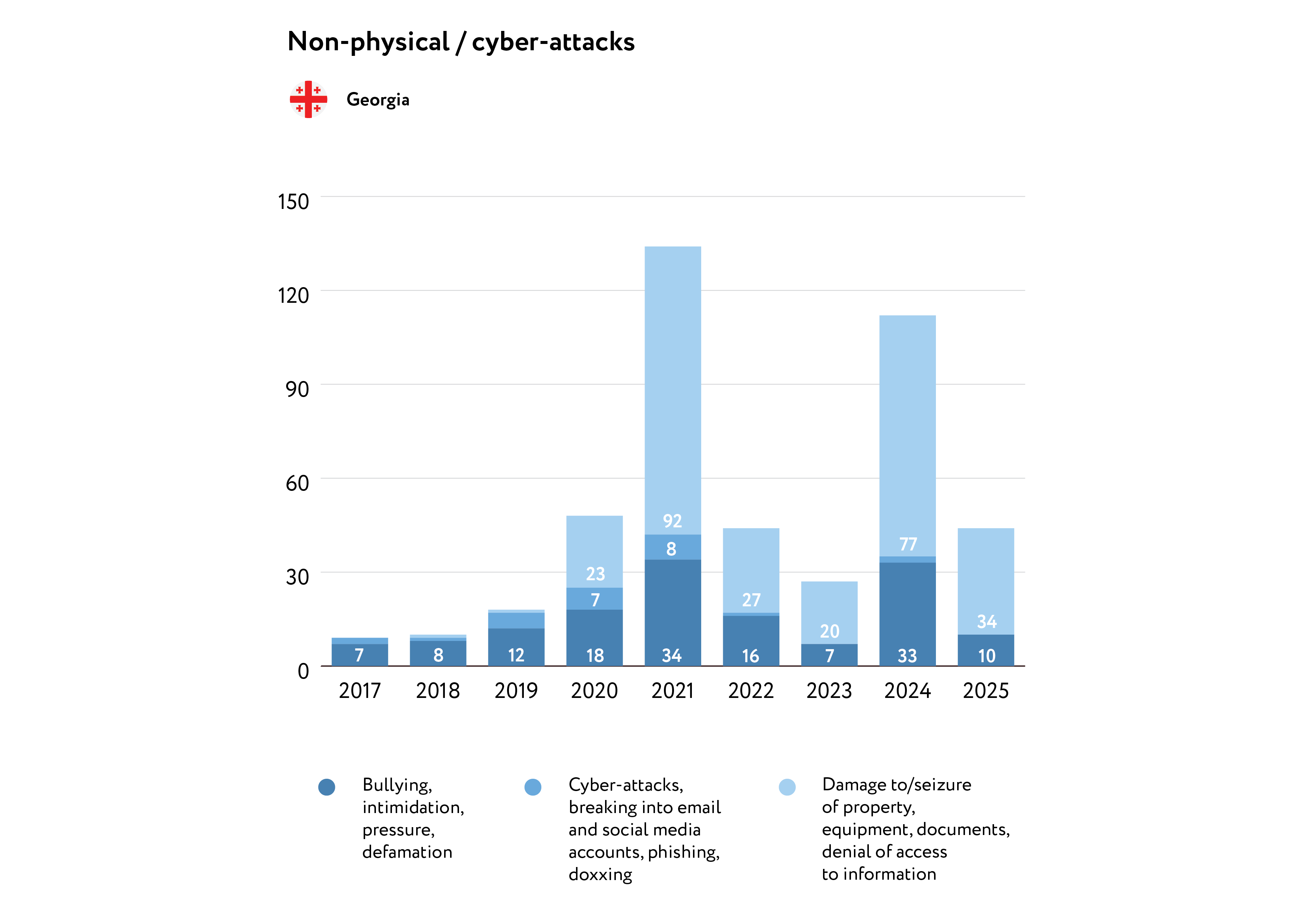
- On 2 February police interfered with the work of Media Aprili photographer Vakho Kareli, who was documenting the use of physical force by police during arrests of protesters near the Tbilisi Mall. Officers prevented the journalist from taking photographs and forced him to leave the area.
- On 3 February, journalist and editor of Mtis Ambebi (Mountain Stories), Gela Mtivlishvili, reported that his work vehicle had been damaged. CCTV footage showed an individual throwing stones at the car, shattering the windscreen. Mtivlishvili is one of the organisers of the journalists’ protests demanding the release of Mzia Amaglobeli.
- On 4 October, journalists from Project 64, Netgazeti, and Mautskebeli lost control of their drones while filming a large-scale anti-government protest in Tbilisi on election day. Drone control was seemingly taken over by law enforcement agencies who also interfered with GPS signals in the city.
- On 13 November, the Georgian parliament suspended the media accreditation of Tiko Eradze, a journalist with Formula TV, for one month after she took a photograph of a ruling party member.
5/ ATTACKS VIA JUDICIAL AND/OR ECONOMIC MEANS
In 2025, attacks carried out via judicial and/or economic means remained the primary method of pressure against media workers, with 171 cases recorded. This represents a more than twofold increase compared with 75 cases documented in 2024. The three most common methods of attack were administrative and criminal proceedings (50 cases), fines imposed following administrative offences (40 cases), and court trials (37 cases).
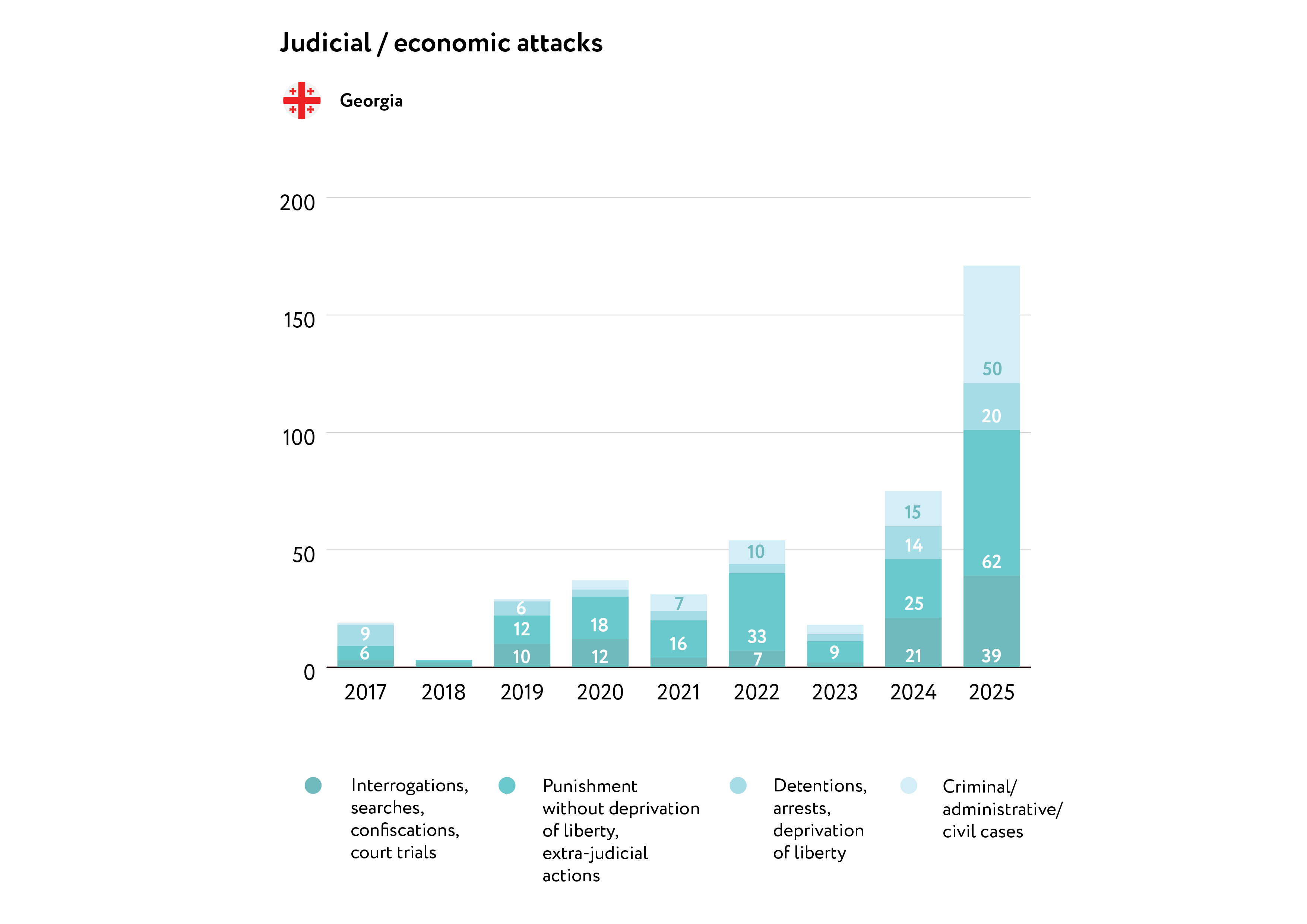
In 2025, Georgian police arrested and imprisoned journalist and media manager Mzia Amaglobeli, co-founder of the online outlets Batumelebi and Netgazeti. She was first detained on 11 January on administrative charges during a protest for putting a sticker on a wall. She was released after a few hours but was arrested again on the same day for slapping Batumi police chief Irakli Dgebuadze. Amaglobeli was subjected to abuse during her detention, including being spat on by Dgebuadze. On 6 August, Amaglobeli was sentenced to two years in jail. According to her lawyers, she was denied adequate access to healthcare while in custody. As a result, her vision dramatically deteriorated to ten percent in her right eye, and to 0.04% in her left eye.
Several media workers covering protests faced legal consequences, including fines or arrest imposed by the courts. Examples of such incidents include:
- On 17 March, the Tbilisi City Court convicted Publika journalist Aleksandre Keshelashvili of disobeying the police during a large anti-government protest on 29 November. While on duty at the protest, Keshelashvili was detained, severely beaten (eventually requiring nasal surgery), and had two cameras confiscated by the police. He was subsequently charged with disobeying the police and petty hooliganism. Although the latter charge was dropped, he was found guilty of disobedience and received a verbal reprimand from the court.
- On 17 April, police fined OC Media co-founder and photographer Mariam Nikuradze for “artificially blocking the road” on 3 April while she was covering a protest. Nikuradze was fined four times, for a total of GEL 20,000 (approximately EUR 6,370).
- On 7 July, Judge Romeo Tkeshelashvili fined journalist Nino Tarkhnishvili GEL 200 (approximately EUR 62) for allegedly failing to stand at the start of a court hearing. According to Netgazeti, Tarkhnishvili did stand but sat down shortly afterwards. The judge justified the fine by stating she had not received permission to sit.
- On 23 October, the Tbilisi City Court sentenced Azerbaijani exiled journalist Afgan Sadygov to 14 days of administrative detention for allegedly “artificially blocking the road” on Rustaveli Avenue.
- On 25 October, Formula TV host and writer Zviad Kvaratskhelia was detained and sentenced to three days of administrative detention for allegedly “artificially blocking the road” on Rustaveli Avenue. Several other Formula TV employees were also detained and sentenced to administrative detention on the same charges.
- On 22 December, police arrested Tamar Mearakishvili, an ethnic Georgian journalist and activist based in occupied South Ossetia, on charges of “espionage”. She was held in pre-trial detention for two months. Mearakishvili has been a vocal critic of the de facto authorities for many years. Criminal proceedings against her began in 2017 in connection with her journalistic work and social media activity. Since then, she has been deprived of her identity documents and has been unable to travel outside South Ossetia.
In 2025, nine foreign media workers were denied entry to Georgia: Italian journalist Giacomo Ferrara, Swiss photojournalist Gregor Sommer, French photographer Marylise Vigneau, Dutch journalist Joost Bosman, French journalist Clément Girardot, photojournalists Jérôme Chobeaux and Hicham El Bouhmidi, British journalist Will Neal, and Azerbaijani journalism student and freelance journalist Javid Ahmedov.
Among other incidents reported in 2025:
- On 11 April, Georgian Public Broadcaster terminated employment contracts with journalist and host Nino Zautashvili and news anchor Vasil Ivanov-Chikovani, citing “damage to the reputation of the broadcaster” due to their statements regarding the channel’s policies. The same justification has reportedly been used to dismiss other employees as well. Protests against the broadcaster have been ongoing for months, with demonstrators demanding impartial coverage of events in Georgia. The broadcaster is widely perceived as having a pro-government stance.
- On 2 June, the ruling Georgian Dream party filed a complaint with the Communications Commission against opposition TV channels, invoking recently adopted amendments to the broadcasting law.
- On 3 June, the personal bank account of Gela Mtivlishvili, founder and director of the independent media outlets Mtis Ambebi and Sakartvelos Ambebi, was frozen. According to Mtivlishvili, he was never officially notified of the relevant court ruling.
- On 16 July, the Prosecutor’s Office entered the offices of Mtavari Arkhi to demand financial documents as part of an investigation into an alleged embezzlement case. Mtavari Arkhi halted its broadcasts in May due to financial difficulties and currently operates solely through social media.
- On 26 July, the Revenue Service of Georgia seized accounts of the online newspaper Batumelebi. Batumelebi had a recognised debt of GEL 47,000 (EUR 14,900), which it was prepared to pay in instalments; however, the extension was not granted. Similar measures were taken against Radio Tbilisi after its owner wrote a critical post about a ruling Georgian Dream official.
ANNEX 1: OPEN SOURCES USED FOR GATHERING DATA (GEORGIA)
- Batumelebi– a news and analysis website about events based in Batumi, Georgia, in Georgian;
- Center for Media, Information, and Social Studies (CMIS) – a non-government organisation focusing on media freedom, disinformation, and journalists’ safety;
- Caucasian Knot – a news and analysis website about events in the Caucasus, in the Russian language;
- Civil.ge – a project by the UN Association of Georgia, delivering news and analysis since 2001;
- European Centre for Press and Media Freedom(ECPMF) – a non-profit organisation that promotes, protects and defends the right to a free media and freedom of expression throughout Europe;
- Freedom House – an international human rights NGO that evaluates and publishes reports on the level of freedom in 210 countries and territories worldwide, including on freedom of speech and media activity;
- First Channel – the news website of the Public Broadcasting of Georgia television channel, in the Georgian and Russian languages;
- Formula TV – a news television channel, in the Georgian language;
- Georgian Charter of Journalistic Ethics – an independent union of journalists aimed at raising the social responsibility of media through the protection of professional and ethical standards, and the development of self-regulation mechanisms;
- Mtavari Arkhi – a Georgian-language television channel;
- Netgazeti.ge – a Georgian-language news and analysis website about events in Georgia;
- OC-Media – an independent online news platform covering news from the North and South Caucasus regions;
- On.ge – a news website about events in Georgia and the Caucasus, in the Georgian language;
- Radio Tavisupleba – the website of Radio Liberty’s Georgian service, in the Georgian language;
- Reporters Without Borders — an international non-profit and non-governmental organisation with the stated aim of safeguarding the right to freedom of information;
- Tabula– a Georgian-language news and analysis website about the politics and economy of Georgia.