AUTHOR OF THE REPORT: ASSOCIATION OF INDEPENDENT PRESS OF MOLDOVA
PHOTO: Journalist Andrei Captarenco (TV8) is struck in the head with a flagpole while covering a protest. A screenshot from a TV8 video.
1/ KEY FINDINGS
In the Republic of Moldova, 97 cases of attacks/threats against professional media workers and editorial offices of both traditional and online publications were identified and analysed in the course of the study for 2025. Data for the study were collected using open-source content analysis in Romanian, Russian, and English. A list of the main sources is presented in Annex 1.
- 2025 saw the highest number of incidents reported since 2017. 77 incidents involved non-physical and/or cyber-attacks and threats.
- A total of 12 physical attacks and threats to life, liberty and health were recorded, most of which occurred while journalists were covering protests organised by political parties.
- A quarter of all attacks took place in August and September 2025, during the parliamentary election campaign.
- An increased number of attacks on Moldovan journalists were perpetrated by the separatist authorities of the Transnistrian region, including cases of illegal interrogations, confiscation of equipment, and deletion of journalistic material.
It should be noted that some attacks and threats are not publicly reported and are not covered by the media, as many journalists consider cyber-attacks and non-physical threats to be a routine occupational risk, which may contribute to underreporting.
2/ THE POLITICAL SITUATION AND THE MEDIA IN MOLDOVA
In 2025, the Republic of Moldova ranked 35th out of 180 countries in the World Press Freedom Index published by Reporters Without Borders (RSF), representing a decline from 31st place in 2024. According to RSF, “Moldova’s media are polarised between pro-Russian and pro-Western camps, but the control that oligarchs and political leaders exert over editorial positions has decreased compared to previous years.”
According to the September 2025 Barometer of Public Opinion (a survey conducted by the Center for Social Studies and Marketing “CBS-Research” and the Institute for Public Policy), 81% of Moldovan citizens use the internet on a daily basis, 50% watch television daily, 26% listen to the radio daily, and 8% read newspapers daily. Social media platforms are the primary channels for obtaining information: 54% of citizens get their news via Facebook, 30% via YouTube, 27% via TikTok, and 19% via Instagram.
According to the Index on the Media Situation in Moldova (ISPM) for 2025, published by the Independent Journalism Center (IJC), journalists’ safety recorded the most significant regression. This occurred amid frequent incidents of intimidation and assault against reporters in public spaces, online harassment, and the normalisation of hostile discourse towards the press.
The most important event of 2025 was the parliamentary election held on 28 September. A statement from the Civic Coalition for Free and Fair Elections regarding these elections notes that the Republic of Moldova was the target of an unprecedented malicious influence campaign carried out by the Russian Federation and its affiliated networks. Extensive coordinated disinformation campaigns aimed at undermining trust in institutions and the exploitation of fears related to security and war were observed on online platforms.
A central component of disinformation involved the use of social media through fake accounts, “troll farms,” and bots, intended to artificially amplify political messages. Some campaigns used deepfake videos to create confusion by disseminating fabricated content without clear indicators of manipulation. A report from the joint observation mission, which included representatives from the Organization for Security and Cooperation in Europe (OSCE), the Office for Democratic Institutions and Human Rights (ODIHR), the OSCE Parliamentary Assembly, the Parliamentary Assembly of the Council of Europe (PACE), and the European Parliament, suggests that digital platforms responded slowly and inadequately to alerts from the authorities and non-governmental organisations. TikTok reported the removal of more than 250,000 fake accounts and millions of artificial interactions. However, other major platforms, such as Meta, Google, and Telegram, did not publish comparable data and were considered to be insufficiently responsive.
In 2025, Moldova began implementing a law adopted in 2024 establishing the Media Subsidy Fund, which enables media outlets to access public funds through a competition organised by the Ministry of Culture. Decisions on fund allocation are made by a board of independent experts, most of whom are appointed by the Press Council, the national self-regulatory body for journalism. In 2025, public funds were allocated to 23 media projects.

“Attacks usually stem from fear and frustration. When people cannot control what journalists write or convince them with arguments, they try to intimidate them. These threats are not directed at specific journalists, but rather are intended to create fear and confusion, especially during sensitive periods such as elections. They cannot leave you indifferent. They make you feel uncertain and tired, especially when you see that such cases remain unsolved. But they do not discourage me. On the contrary, they confirm that journalistic work matters and that silence is precisely what those who send such “messages” want.”
Daria Slobodcicova, Newsmaker.md portal
3/ GENERAL ANALYSIS OF ATTACKS
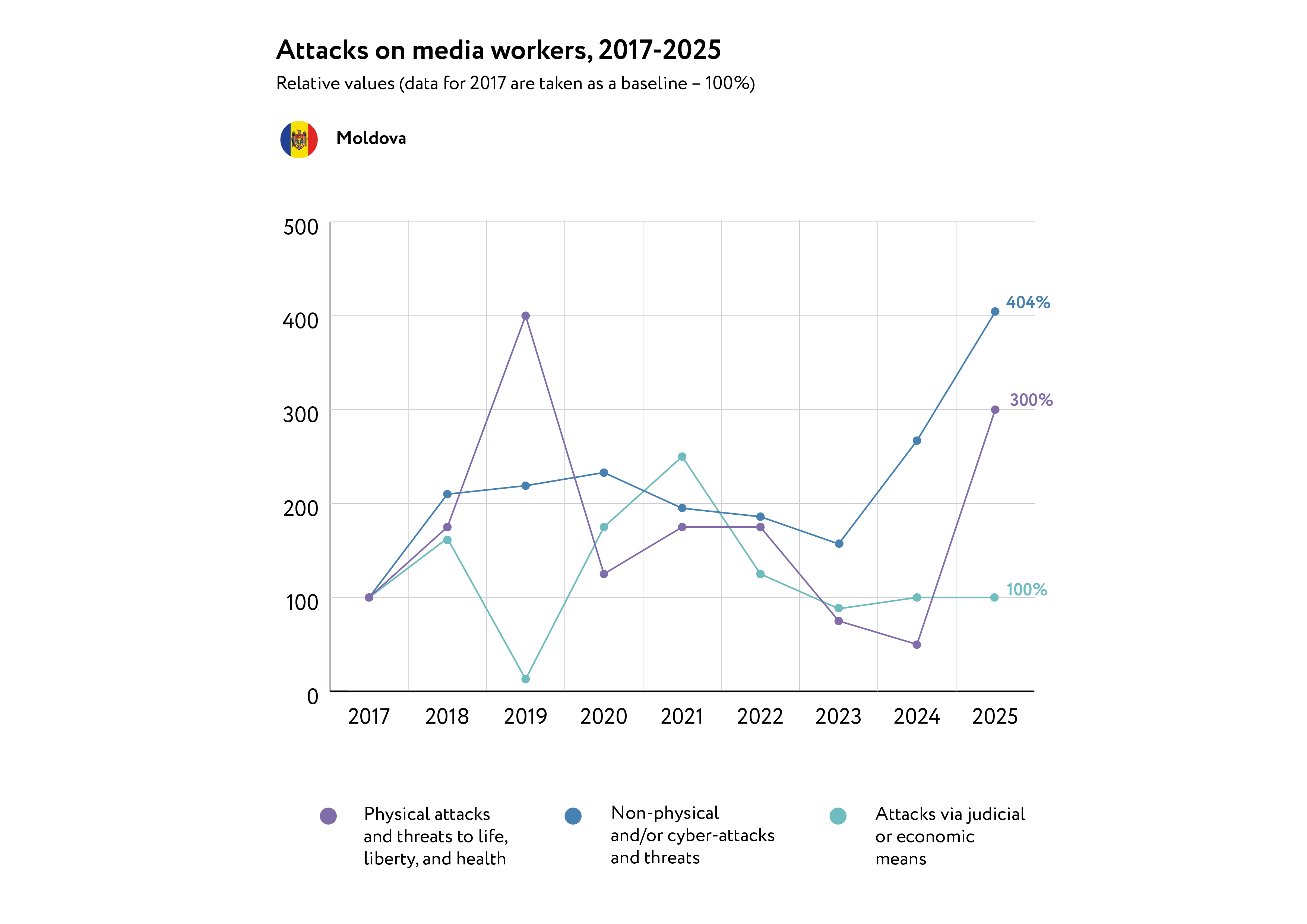
A total of 97 attacks on media workers in Moldova were reported in 2025, the highest number of incidents recorded since monitoring began in 2017. This represents a 47% increase compared with the previous year, when 66 attacks were reported. Non-physical and/or cyber-attacks and threats remained the main method of pressure on media workers (77 cases), followed by physical attacks and threats to life, liberty and health (12 incidents), and attacks carried out via judicial and/or economic means (eight cases).
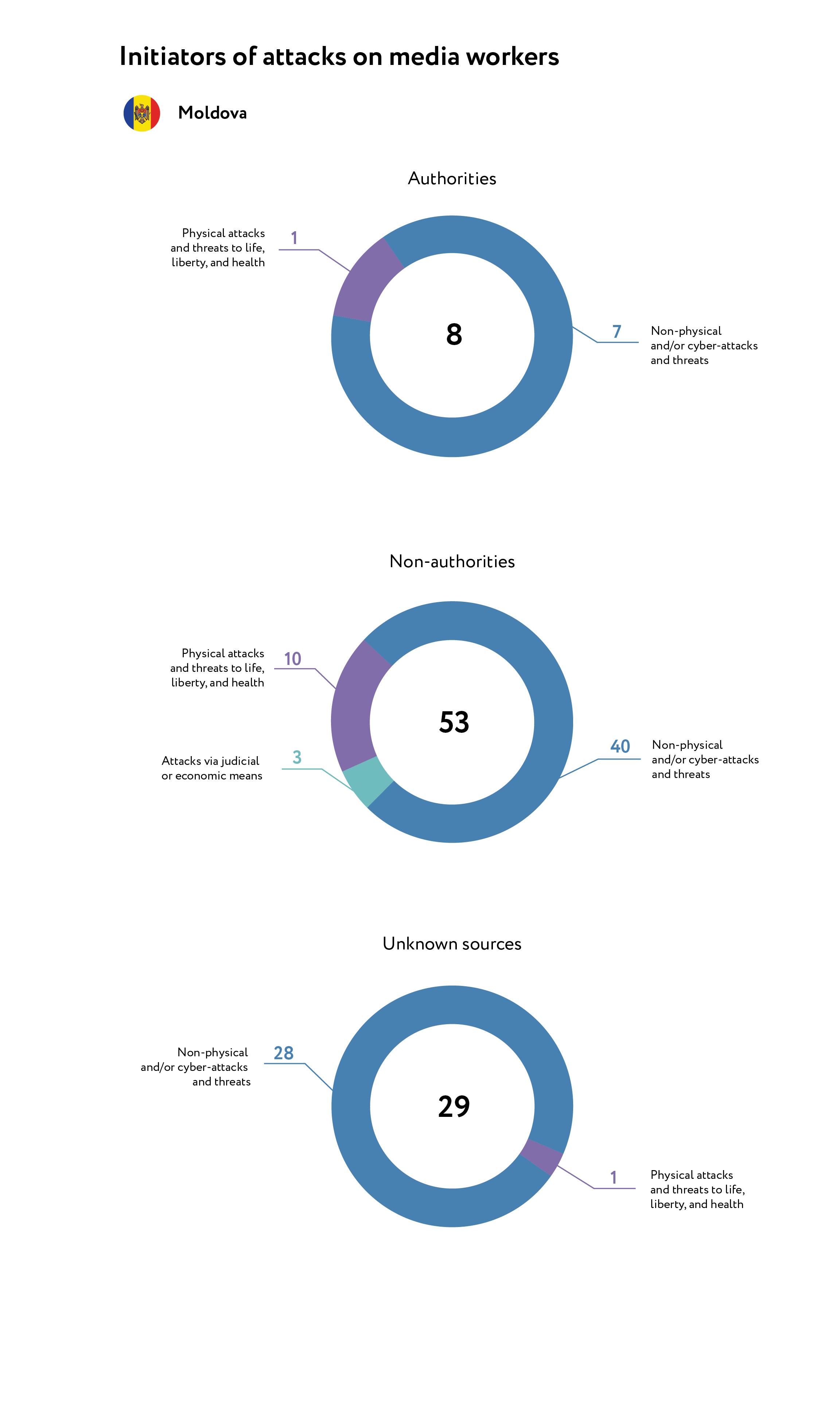
The main perpetrators of attacks on media workers were individuals who were not representatives of the authorities, including some members of political entities that participated in the parliamentary elections in September 2025 (53 incidents), and unknown individuals (29 incidents). Representatives of the authorities were responsible for 8 attacks, including in the Gagauz autonomy, municipal, and district authorities, as well as one case of intimidation by the Speaker of the Parliament of the Republic of Moldova. Five attacks on Moldovan journalists were perpetrated by so-called peacekeeping forces in the Transnistrian region, which is not controlled by the constitutional authorities. In two cases, media workers were attacked by representatives of the authorities of a foreign state.
In 2025, employees of 32 media outlets and organisations in Moldova were subjected to attacks or threats, representing the highest number since 2017. The most frequently targeted outlets were the investigative publication Ziarul de Gardă (ZdG.md) with 12 incidents, TV8 (Tv8.md) with 11 incidents, and Nokta.md, a media outlet operating in the Autonomous Territorial Unit of Gagauzia, with ten incidents. Other affected outlets included the CU SENS media project (five incidents), the Newsmaker.md and Stopfals.md portals, as well as institutions within the public broadcaster Teleradio-Moldova (five incidents each). The Nordnews.md portal, RISE Moldova, and the FĂRĂ FILTRE media project each recorded four incidents, while the Realitatea.md and Laf.md portals, along with freelance journalist Nicolae Chicu, were each targeted in three incidents.
4/ PHYSICAL ATTACKS AND THREATS TO LIFE, LIBERTY AND HEALTH
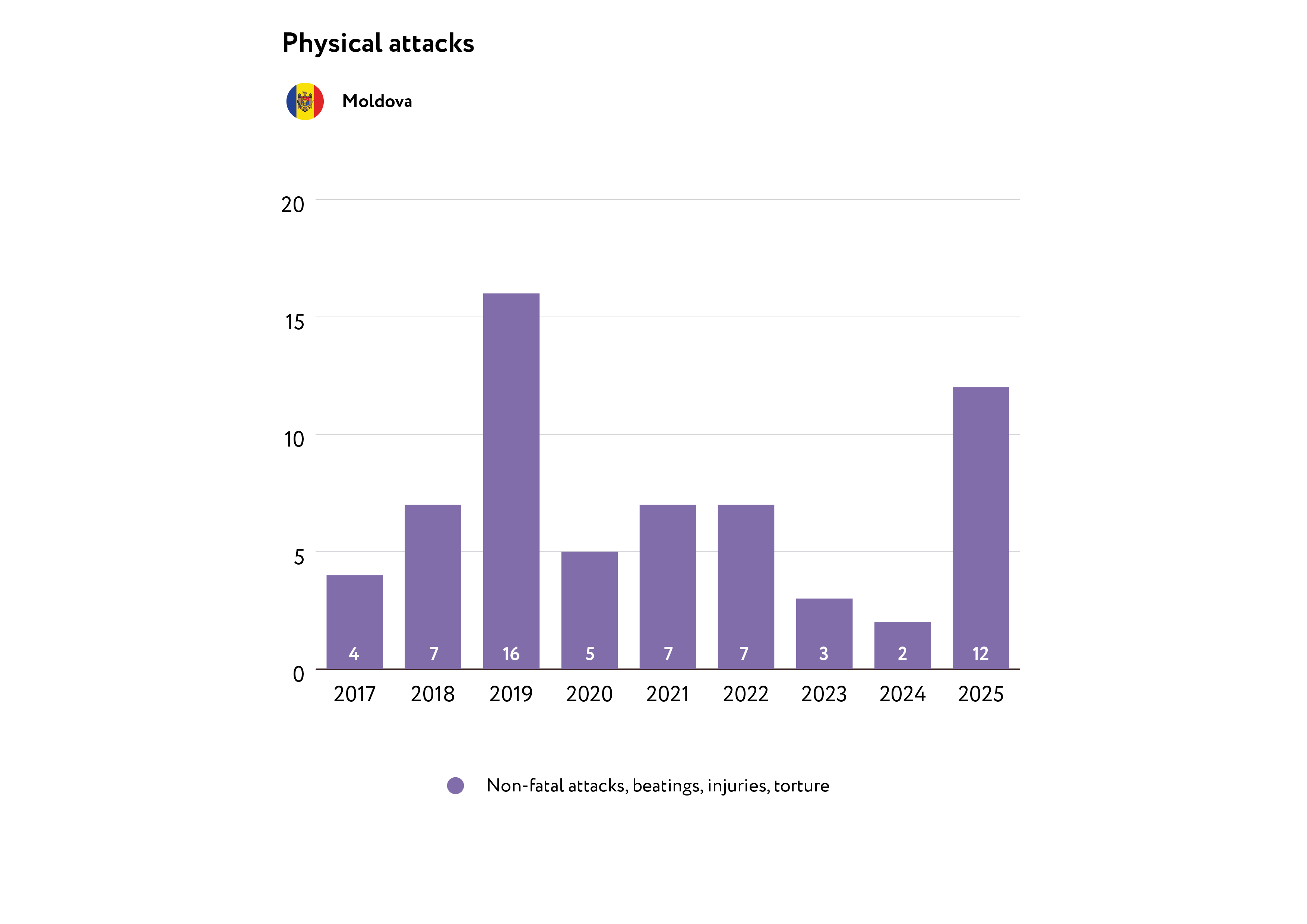
In 2025, 12 cases of physical attacks and threats to life, liberty and health against media workers were reported, representing the highest number recorded since 2019, when 16 physical assaults were documented.
The attacks occurred while journalists were covering political events, including events organised by political parties, and high-profile court proceedings related to electoral corruption and the illegal financing of political parties. Documented incidents include the following:
- On 12 February, Malvina Cojocari, a journalist working for the media project CU SENS, was assaulted by several supporters of Evghenia Guțul, the Governor of the Autonomous Territorial Unit of Gagauzia, who is on trial on charges related to passive corruption and the illegal financing of political parties. The journalist was pushed by several individuals, who also attempted to seize her notebook.
- On 7 March, Ziarul de Gardă journalists Măriuța Nistor and Igor Ionescu were assaulted by an individual while covering a demonstration organised by political parties affiliated with convicted oligarch Ilan Șor. The demonstration took place outside a court hearing involving MP Alexandr Nesterovschi, who is under investigation on charges related to passive corruption and the illegal financing of political parties.
- On 27 June, Nadejda Roșcovanu, a photojournalist for Jurnal.md, reported an attack inside Chișinău City Hall. During a break in the budget vote, amid mutual accusations between councillors, one municipal councillor insulted the photojournalist, while another shoved her and prevented her from filming.
- On 3 July, TV8 journalist Andrei Captarenco was struck with a flagpole by a protester supporting Evghenia Guțul outside the Buiucani District Court in Chișinău. Another protester shoved the journalist and struck his camera with their hand.
- On 5 August, during the protest in support of Evghenia Guțul, journalists Veronica Gherbovețchii and Constantin Niculae from the media project FĂRĂ FILTRE were repeatedly pushed by protesters.
- On 16 August, TV8 journalist Viorica Tătaru was reporting on an anti-government protest organised by pro-Russian parties affiliated with fugitive convict Ilan Șor at the Chișinău Railway Station when she was attacked by protesters. A man shoved her and a woman struck her in the face.
5/ NON-PHYSICAL AND/OR CYBER-ATTACKS AND THREATS
Non-physical and/or cyber-attacks and threats remained the most frequent form of pressure on Moldovan media outlets. In 2025, 77 such incidents were reported, representing the highest number recorded to date. After a decline in non-physical attacks during the 2021–2023 period, the number of such incidents increased over the past two years.
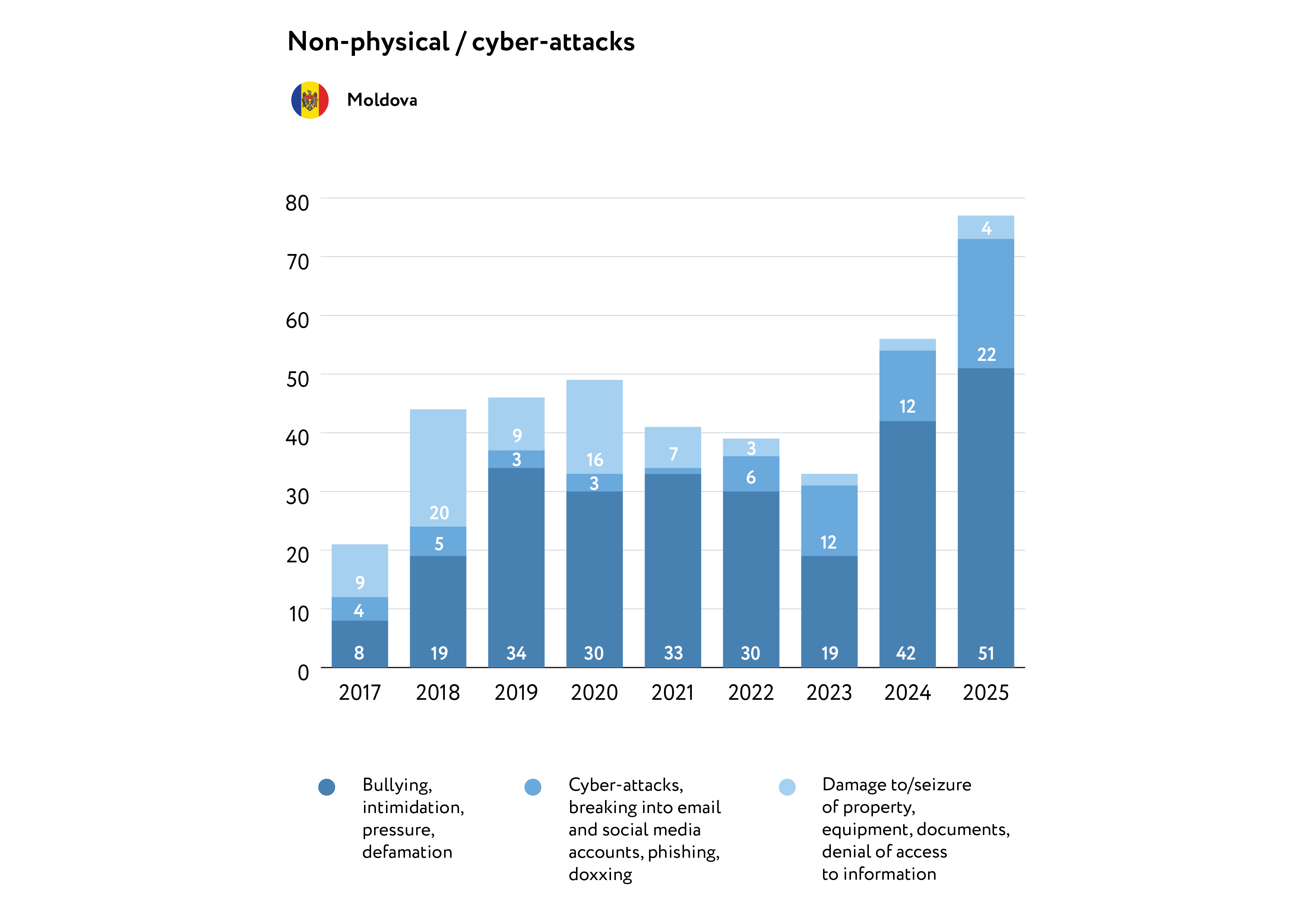
The vast majority of non-physical attacks against media workers took the form of bullying, intimidation, pressure, and defamation (51 incidents). This was followed by cyber-attacks, including breaking into email and social media accounts, phishing, and doxxing (22 incidents), as well as damage to/seizure of property, equipment, documents, and denial of access to information (four cases). Documented examples included the following:
- On 25 January, a comment containing insults and threats was posted in a social media group where journalist Natalia Cebotari’s critical address to the authorities of the Autonomous Territorial Unit of Gagauzia had been shared. The comment stated that the journalist’s “venomous tongue will be torn out.”
- Since February 2025, following the withdrawal of USAID funding for independent media, several journalists and newsrooms have faced intimidation, labelling, and accusations of being funded by what was described as the “USAID-organised crime group.” Those targeted included journalists Alina Radu (Ziarul de Gardă), Cornelia Cozonac (Center for Investigative Journalism), Mariana Rață (TV8), Mihail Sirkeli (Nokta.md), Vladimir Thoric (RISE Moldova), as well as the portals Laf.md, Mold-street.com, Moldova.org, and Nordnews.md, among others.
- In April and May, several media platforms, including Realitatea Media Group, Nokta.md, Newsmaker.md, Esp.md, Bas-tv.md, Știri.md, were subjected to large-scale cyber-attacks involving bots and repetitive comments from fake accounts.
- On 27 July, the headquarters of the public company Teleradio-Moldova was vandalised. Unknown individuals sprayed red and black paint on the columns and windows of the Radio House, the institution’s administrative centre.
- In August and September, several media platforms were subjected to cyber-attacks and cloning, including Nordnews.md, Moldova1.md, RadioMoldova.md, Nokta.md, Diez.md, Jurnal TV, Moldova 1, and TV8.
- On 27 August, Daria Slobodcicova and Olesea Bolboceanu, journalists from the Newsmaker.md and Unimedia.md respectively, received threatening messages apparently intended to discredit a candidate in the upcoming parliamentary elections. The messages stated: “We know where you live. We know where you work. We can kill you. Choose Maia Sandu and save your lives!”
- On 2 September, journalist Nicolae Chicu’s YouTube channel was deleted two hours after it was hacked by Russian intelligence services. The hackers broadcast a live cryptocurrency scam, which triggered the channel’s closure.
- In October, Mihai Avasiloaie and Dana Ciobanu, journalists from the Stopfals.md portal, were repeatedly intimidated and threatened with arrest and imprisonment by the subject of an article they had fact-checked and published.
- On 20 October, Elena Celac, a journalist from Radio Moldova Comrat, was the target of a smear campaign by local politicians and their supporters following a radio broadcast with a deputy from the People’s Assembly of the Gagauz autonomy. She was subjected to insults and threats.
- On 30 October, TV8 journalist Mariana Rață received several audio recordings containing threats and insults from a Facebook user claiming to be a supporter of a political party. Unsatisfied with the questions the journalist asked the party leader during a television programme, he threatened the journalist, saying: “People will put a knife to your throat.”
- Throughout 2025, several deepfake videos created using artificial intelligence tools were circulated. These videos fraudulently used images of journalists and logos of media outlets to spread false information and promote scams. Those targeted by this type of attack included: Mariana Rață (TV8), Stela Untilă and Daria Slobodcicova (Newsmaker.md), Ana Dmitrieva (Nokta.md), Ziarul de Gardă, andUnimedia.md.
5/ ATTACKS VIA JUDICIAL AND/OR ECONOMIC MEANS
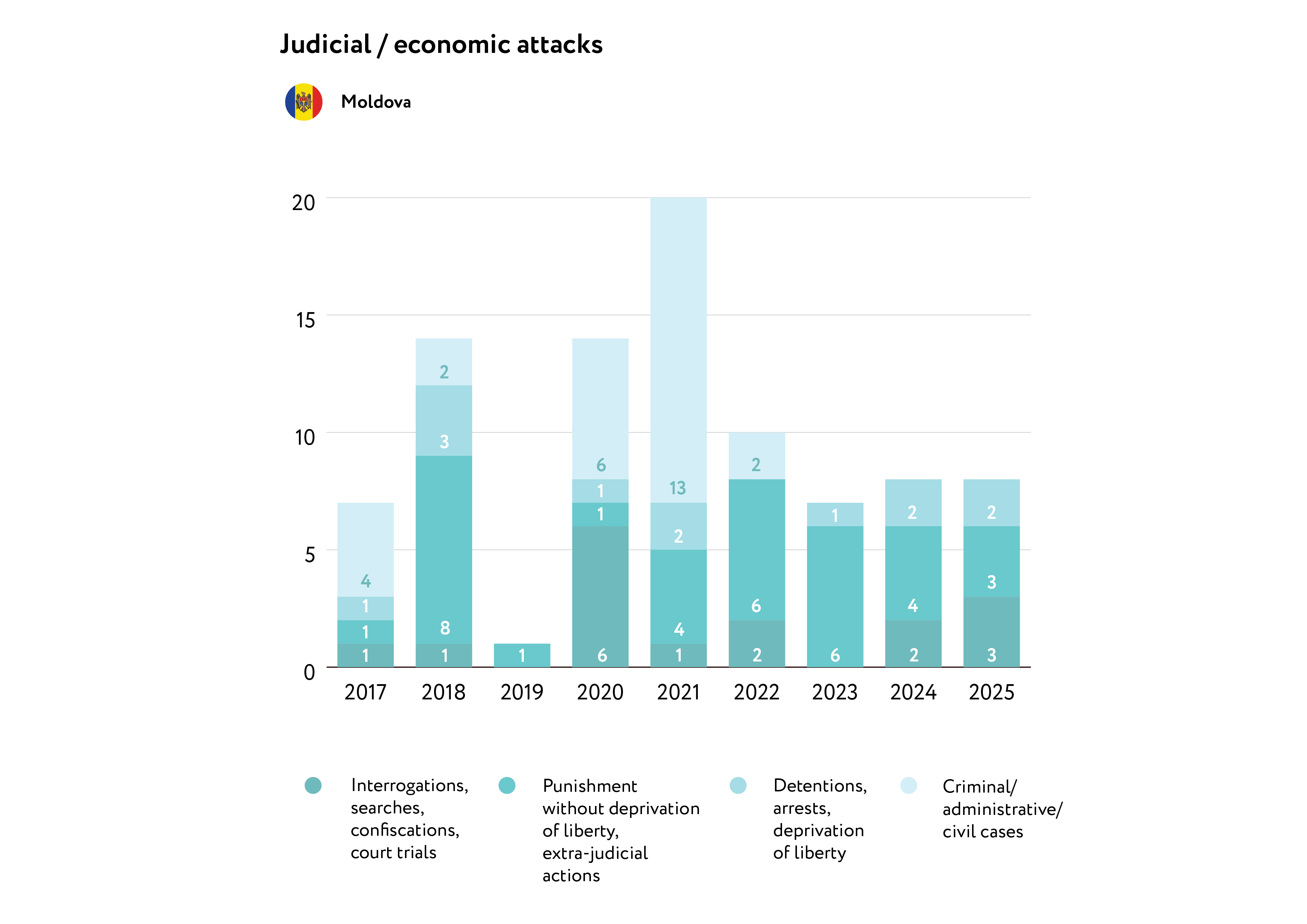
In 2025, eight cases of attacks carried out via judicial and/or economic means were recorded. The reported incidents included interrogations, searches, short-term detentions, warnings, and pre-trial complaints:
- On 28 January, SOTA journalist Timofei Ilyushin was detained in Varnița, in the separatist region of Transnistria, where he was filming a report on the energy crisis. He was threatened with deportation to Russia. Ilyushin is a Russian citizen who has applied for asylum in Moldova but has not yet been granted it. He was pressured to sign an acknowledgement that he had broken the law and had been informed of the rules at the border in Transnistria.
- On 24 March, two activists from the pro-Russian political bloc “Victory”, which is affiliated with fugitive oligarch Ilan Șor, filed slander complaints against the editorial staff of the media project CU SENS. The activists accused the journalists of slander after they reported cases of intimidation at protests organised by the political group.
- On 6 May, the administration of the separatist Transnistrian region refused to accredit a group of journalists from Chișinău who intended to report on events in the region.
- On 10 September, journalists from the GLOSSA media project were detained in Tiraspol by the Transnistrian security services. They were interrogated for two hours and had their equipment confiscated. All footage filmed in Tiraspol was deleted without the journalists’ consent. The security forces warned the journalists that they risked being deported if they returned to the left bank of the Nistru River.
- On 26 September, parliamentary candidate Nicolae Pascaru threatened RISE Moldova with SLAPP (Strategic Lawsuits against Public Participation) lawsuits, sending a preliminary request in which he claimed that a poll published by RISE would cause him to receive fewer votes and threatened to seek “compensation for material damage.” RISE Moldova vehemently rejected the accusations and reiterated its commitment to providing accurate, responsible information in the public interest.
ANNEX 1: OPEN SOURCES USED FOR GATHERING DATA (MOLDOVA)
- Association of Independent Press (API) – a non-commercial organisation that promotes and assists the sustainable development of media organisations and independent journalists at a national and regional level by strengthening professional capacities, increasing resilience and improving public policies in the media field;
- Agora.md – an online Romanian-language news portal;
- Broadcasting Coordinating Council of the Republic of Moldova – a regulatory authority on public and private audiovisual media in Moldova. The CCA (Consiliul Coordonator al Audiovizualului) supervises the enactment of the Broadcasting Code, and issues broadcasting licences and retransmission authorisations;
- Freedom House – an international human rights NGO that evaluates and publishes reports on the level of freedom in 210 countries and territories worldwide, including on freedom of speech and media activity;
- Jurnal.md– an online Romanian-language news portal;
- Institute for Public Policy of Moldova – an independent, nonpartisan and nonprofit organisation, committed to the values of individual liberty, democratic society, rule of law, and free market economy;
- Independent Journalism Centre (CJI) – a non-governmental organisation active in protecting democracy and those who believe in its values;
- National Bureau of Statistics of the Republic of Moldova – a central administrative authority which, as the central statistical body, manages and coordinates activity in the field of statistics in the country;
- Nordnews.md – a regional Romanian-language online news portal (based in the city of Bălți);
- NewsMaker.md – an online Russian and Romanian-language news portal;
- PRO TV Chișinău – a branch of the Romanian television channel in Moldova;
- Reporters Without Borders — an international non-profit and non-governmental organisation with the stated aim of safeguarding the right to freedom of information;
- Rise.md – the internet portal of a group of investigative journalists;
- TV8 – nonprofit television network based in Chișinău, Moldova.