AUTHOR OF THE REPORT: AUTHOR OF THE REPORT: THE COMMITTEE TO PROTECT FREEDOM OF EXPRESSION (CPFE)
PHOTO: FACTOR.AM
1/ KEY FINDINGS
In Armenia, 230 attacks and threats against professional and citizen media workers, as well as editorial offices of traditional and online media outlets, were identified and analysed in the course of the study for 2025. Data for the study were collected using content analysis of open sources in Armenian, Russian, and English. A list of the main sources is provided in Annex 1.
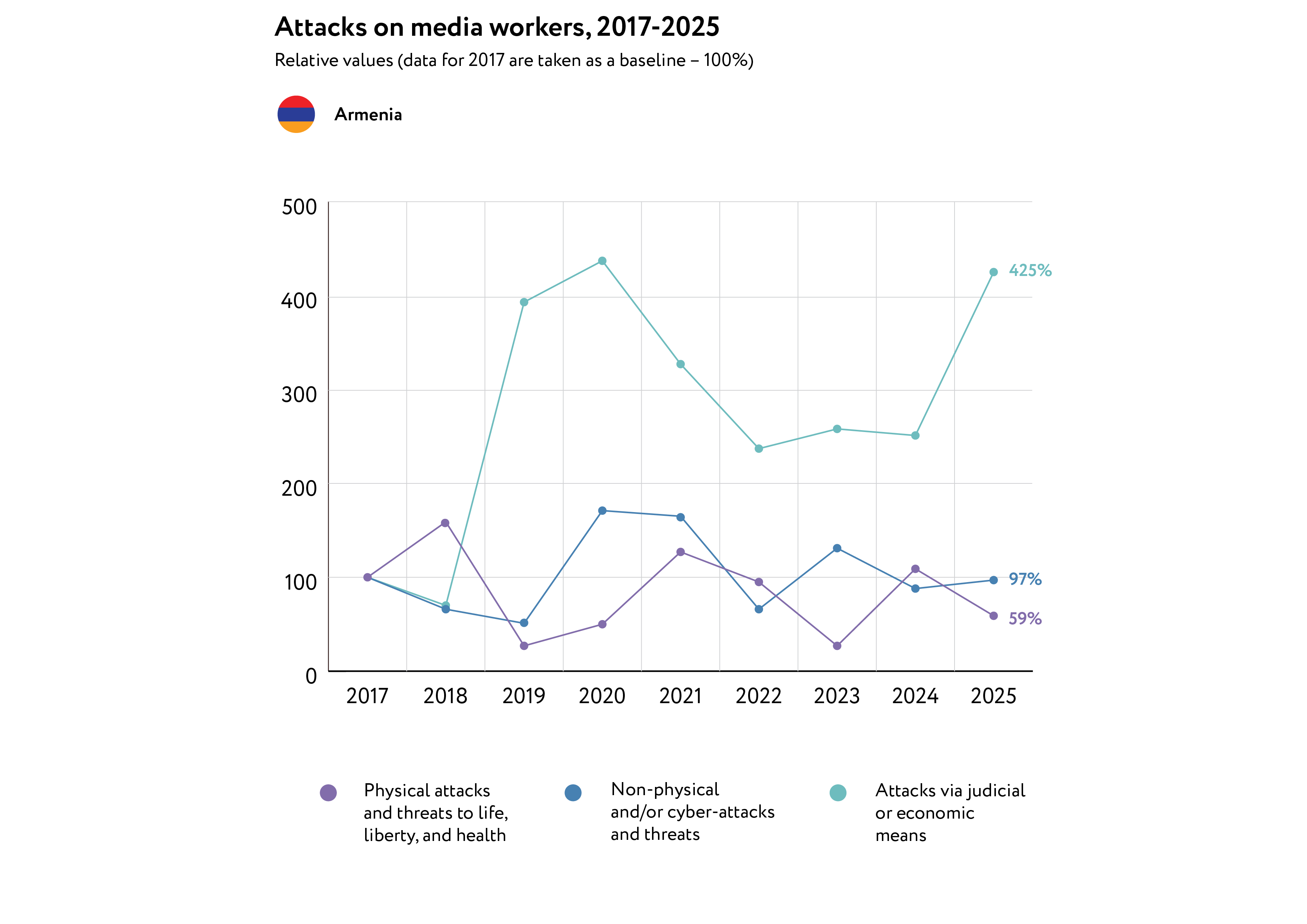
- The total number of attacks in 2025 increased by 30% compared with 2024, with judicial and/or economic means remaining the primary method of pressure.
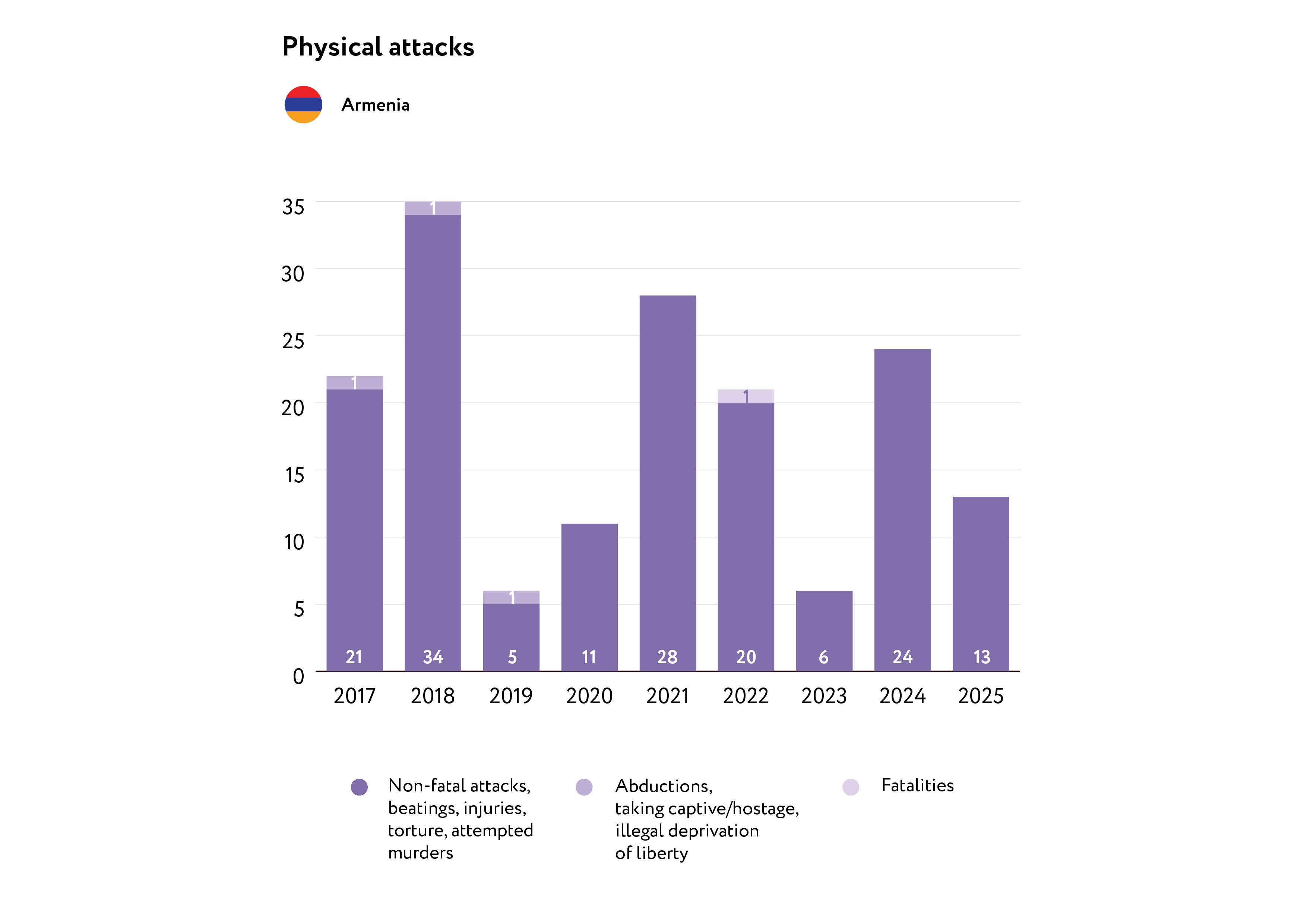
- The number of physical attacks decreased by almost 46% compared with 2024, falling to 13 non-fatal incidents.
- At least 80% of non-physical and/or cyber-attacks and threats were perpetrated by representatives of the authorities.
- In 2025, 183 cases of attacks via judicial and/or economic means were recorded, representing a 41% increase compared with 2024.
- As of the end of 2025, two media representatives remain in detention in Armenia: Vazghen Sagatelyan and Narek Samsonyan, hosts of the podcast “Imnemnimi”.
2/ THE POLITICAL SITUATION AND THE MEDIA IN ARMENIA
In the Reporters Without Borders (RSF) World Press Freedom Index, Armenia ranked 34th out of 180 countries, improving its position by nine places compared with 2024. There are no taboo topics in the country, nor are there opinions or ideas that cannot be published given the existing diversity of media outlets. No journalists were forced to leave the country to avoid persecution for their professional activities. At the same time, despite the overall pluralistic environment, the Armenian media remains politically polarised: some outlets are affiliated with the current leadership, while others continue to serve former oligarchs and political figures.
In the Freedom House report Freedom in the World 2025, Armenia was classified as a country with “partly free” media. The organisation noted that independent and investigative outlets operate relatively freely, while the majority of other media, including broadcasters, remain tied to political and commercial interests.

Due to the termination of USAID’s activities and the sharp shift in the US international assistance policy under the new presidential administration, dozens of media outlets and journalistic organisations were forced to shut down important projects, lay off staff, or in some cases, suspend their operations entirely.
2025 was marked by acute tensions ahead of the parliamentary elections scheduled for June 2026, which will determine whether Armenia maintains its pro-Western course and integration with the EU, or returns to alignment with Russia. The main divide is between the reform-oriented pro-Western government of Nikol Pashinyan, and the radical opposition of Kocharyan and Sargsyan, supported by Moscow.
Tensions between the former and current authorities escalated following the intervention of the Armenian Apostolic Church, which aligned itself with the opposition. Despite the constitutional prohibition on the Church’s involvement in politics, senior church officials have openly demanded Pashinyan’s resignation and have participated in the protest movement.
These processes dominated media coverage, which, due to deep polarisation, presented them in an extremely biased manner, often aligned with the interests of political patrons and sponsors. Some outlets portrayed the authorities’ actions as efforts to counter destabilisation, while others framed them as suppression of the opposition and pressure on the Church.
The close alignment of most media outlets with political actors has turned them into instruments in the struggle for power, distorting the social mission of journalism. Information activity is increasingly reduced to discrediting opponents through fake news, disinformation, manipulation, and insults, leading to conflicts, lawsuits, and pressure on journalists from various sides. This reflects the complex political conditions in which the media operates.
3/ GENERAL ANALYSIS OF ATTACKS
In 2025, the total number of attacks on journalists and media outlets amounted to 230 incidents, representing a 30% increase compared with 2024. The number of physical attacks and threats to life, liberty, and health fell twofold. There was a significant rise – around 41% – in attacks carried out via judicial and/or economic means. The majority of these cases concerned allegations of insults, defamation or reputational harm, while only two lawsuits were related to copyright protection.
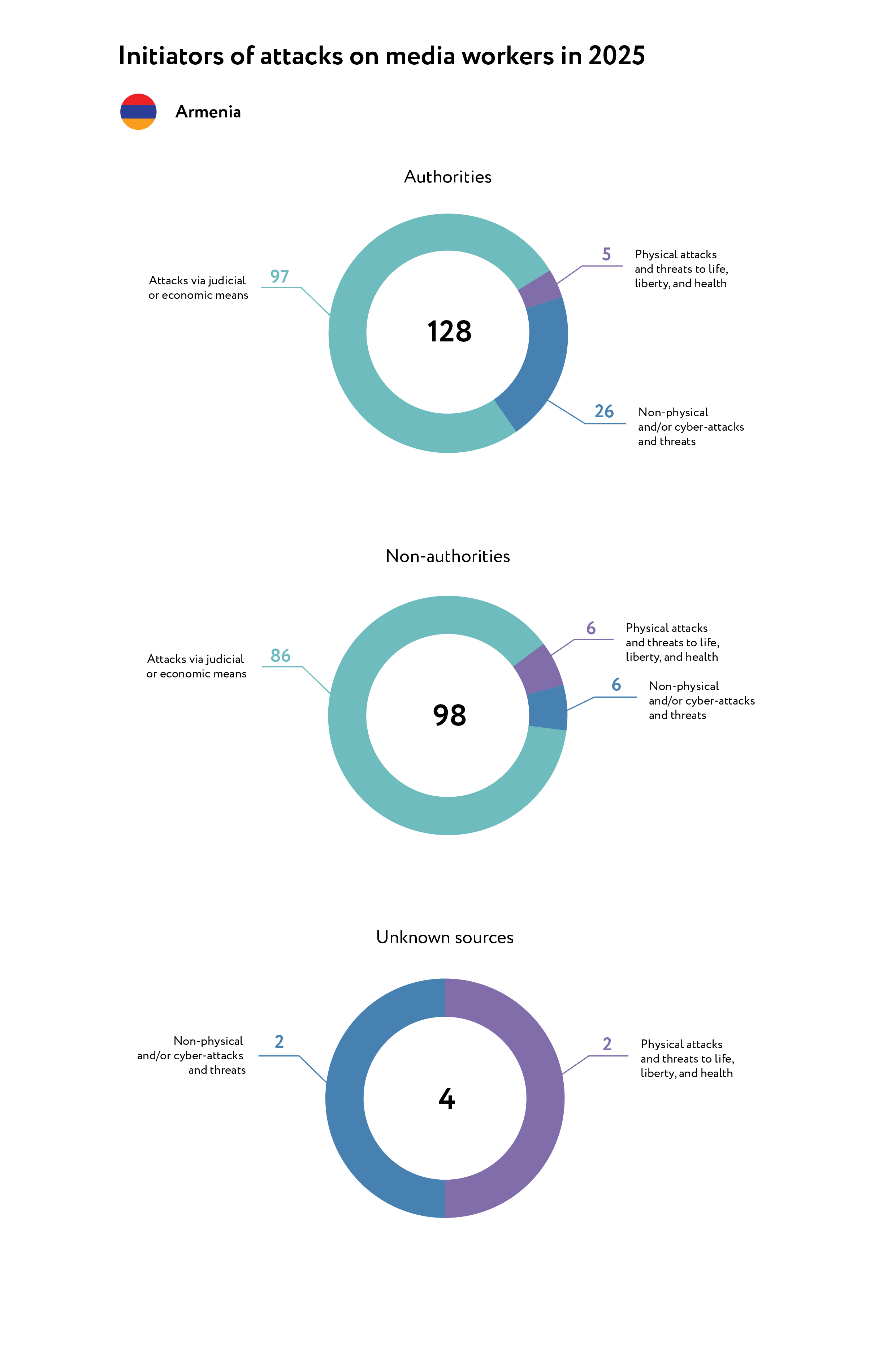
Of the total number of attacks on media workers recorded during the year, 128 incidents originated from representatives of the authorities, 98 from non-state actors, and four from unknown individuals.
4/ PHYSICAL ATTACKS AND THREATS TO LIFE, LIBERTY AND HEALTH
A 46% decrease in cases of physical attacks against media workers compared with the previous year represents a positive development. The majority of these incidents – 7 out of 13 – occurred on the premises of various churches, where representatives of opposition media attempted to interview or obtain comments from parishioners who supported the authorities’ actions against the Catholicos and his close circle. These parishioners had gathered to attend Sunday liturgies in which Prime Minister Nikol Pashinyan also took part.
Two incidents involving the use of physical force against journalists occurred during the coverage of protests, while two more occurred during conflict situations arising in the National Assembly. Examples of physical attacks include:
- On 16 June, an officer of the Armenian Police used excessive force against Meri Manukyan, a correspondent for the news website 24news.am, while she was covering a protest by residents of the village of Kasakh (in the Kotayk region) against changes to the local public transport route. Within hours, the police officer responsible for the assault was dismissed from service.
- On 12 September, journalist and Yerevan Press Club expert Hakob Karapetyan was subjected to physical violence by an unidentified individual. The assailant approached him without warning and struck him multiple times, including blows to the head and face. A criminal case was opened the same day.
- On 19 December, the work of Ani Gevorgyan and Lia Sargsyan, editors of the news websites NewDay.am and Ishkhanutyun.am, was obstructed on the grounds of the Mother See of Holy Etchmiadzin. They were verbally abused by a group of citizens who treated them disrespectfully and offensively. One individual struck their hands and mobile phones, demanding that they stop filming. On 20 December, a criminal case was opened by the Investigative Department of the Armavir region. The investigation is ongoing.
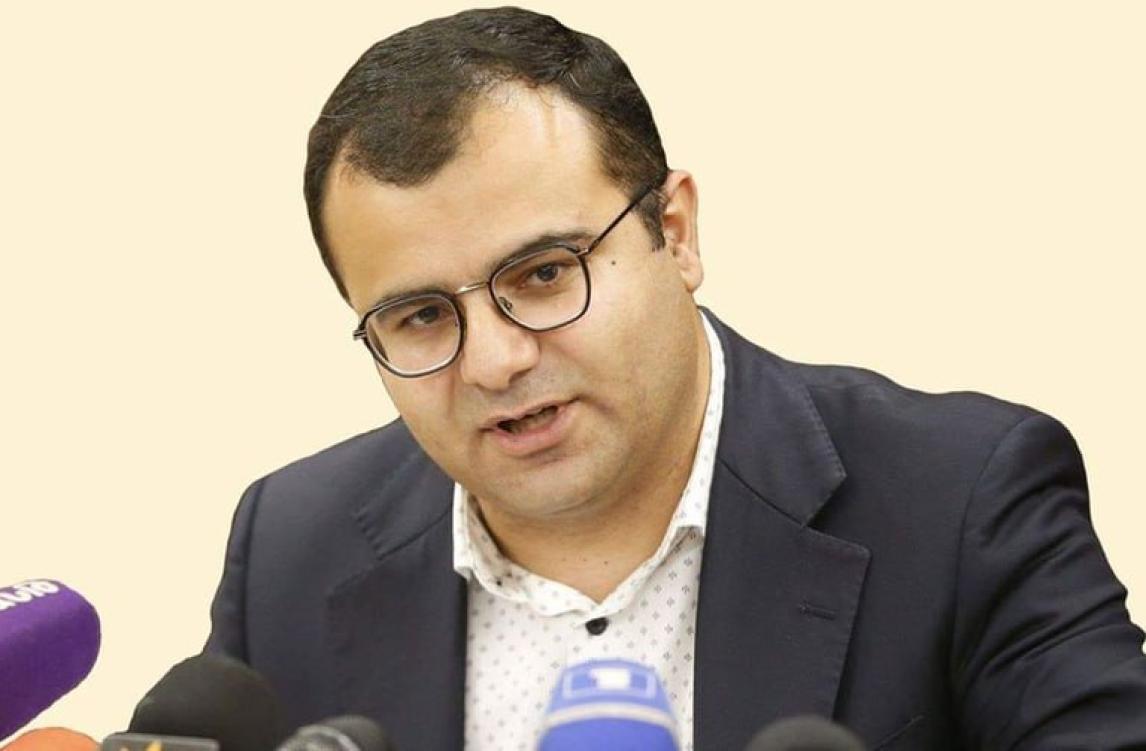
“On the day I was attacked, I went to the police, and a criminal case was immediately opened. However, by the end of the year, there had been no results. Apart from a single interrogation, no investigative actions – such as confrontations – were carried out. Since media outlets close to the ruling party, as well as certain officials – in particular, the RA Minister of Economy and Deputy Chairman of the Civil Contract party board, Gevorg Papoyan – albeit indirectly, publicly justified the violence against me, there are grounds to believe that the criminal investigation is being deliberately delayed for political reasons.”
Hakob Karapetyan, Yerevan Press Club expert and journalist
5/ NON-PHYSICAL AND/OR CYBER-ATTACKS AND THREATS
The most common forms of non-physical and/or cyber-attacks were harassment, intimidation, pressure, and threats of violence or death (25 cases). Other incidents involved unlawful obstruction of journalistic work or denial of access to information (four cases), as well as damage to or seizure of property, vehicles, equipment, documents or journalistic materials (4 cases). The vast majority (80%) of non-physical attacks and threats came from representatives of the authorities.
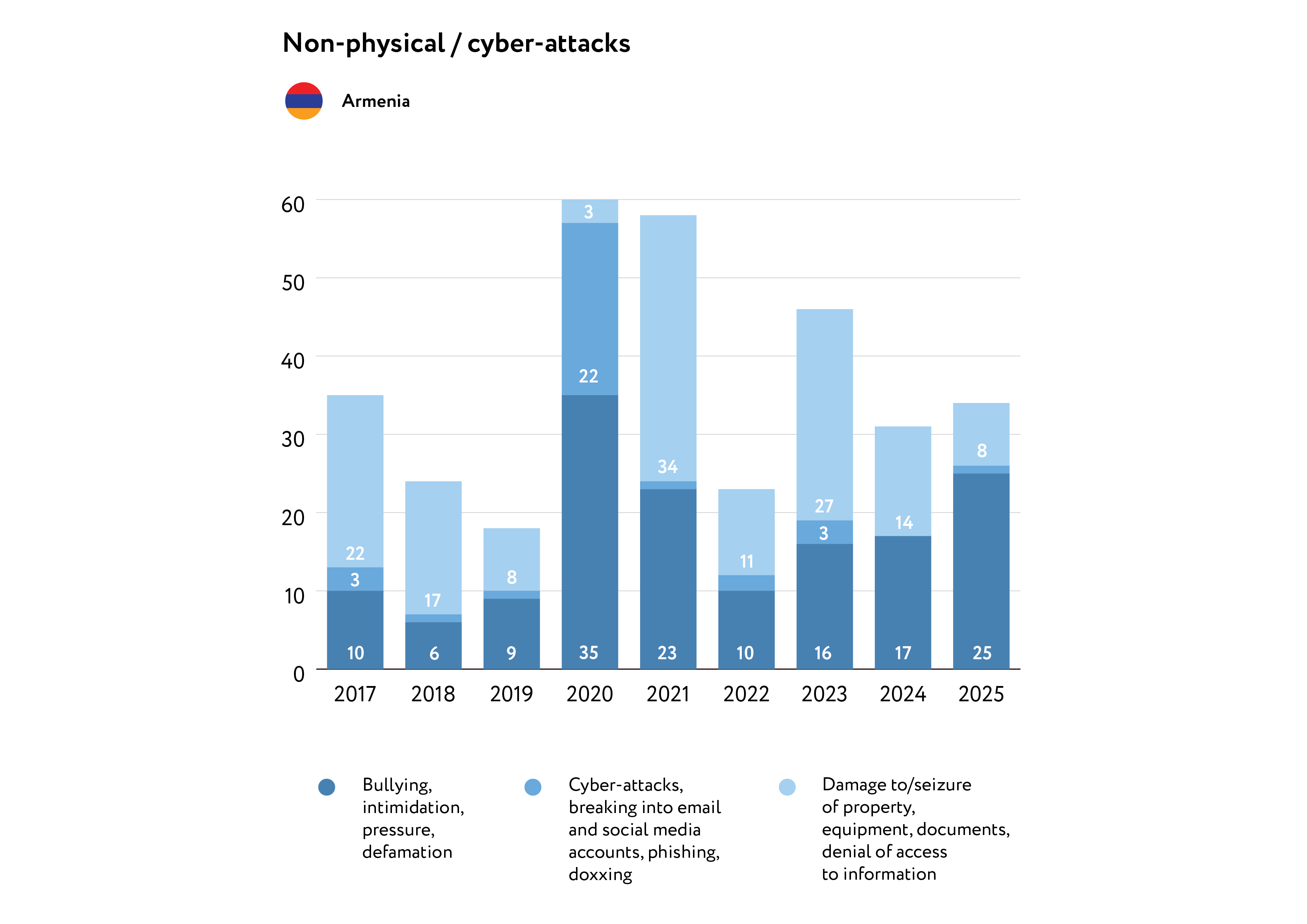
Examples of such incidents include:
- On 6 January, the Telegram channel of the news website News.am was subjected to a cyber-attack. Access to the channel was later restored.
- On 18 April, in the National Assembly, Narek Kirakosyan, a correspondent for the news website Factor.am, approached Khachatur Sukiasyan, an MP from the ruling Civil Contract faction, to request a comment. The MP repeatedly pushed the journalist’s microphone away and said: “… Go away, you are a very bad person, you make money on your YouTube channel, you create scandals so people will watch, be quiet …”
- On 4 June, in the courtyard of the National Assembly, a security officer accompanying Minister of Internal Affairs Arpineh Sargsyan obstructed the work of Knar Manukyan, a parliamentary correspondent for the newspaper Zhoghovurd and the news website Armlur.am, by blocking her access to the minister and preventing her from asking questions.
- On 6 June, journalists’ work was obstructed at the Court of Appeal, where Presiding Judge Mkhitar Papoyan barred Ashot Hakobyan of Aravot.am and Naira Bulghadaryan of Radio Liberty from taking photographs or making audio recordings. The judge later banned the journalists from the courtroom for one hour.
- On 15 September, during a press conference, Yerevan Mayor Tigran Avinyan – speaking in an irritated tone – levelled serious accusations against the media, including large-scale corruption, the circulation of shadow funds, and the publication of commissioned materials.
- On 26 October, users of a Facebook page titled “Free Thoughts” launched a harassment campaign against Ani Gevorgyan, editor of the news website NewDay.am.
5/ ATTACKS VIA JUDICIAL AND/OR ECONOMIC MEANS
In 2025, at least 76 journalists and media outlets faced judicial proceedings for alleged violations of honour, dignity and business reputation, representing a 41% increase compared with 2024.
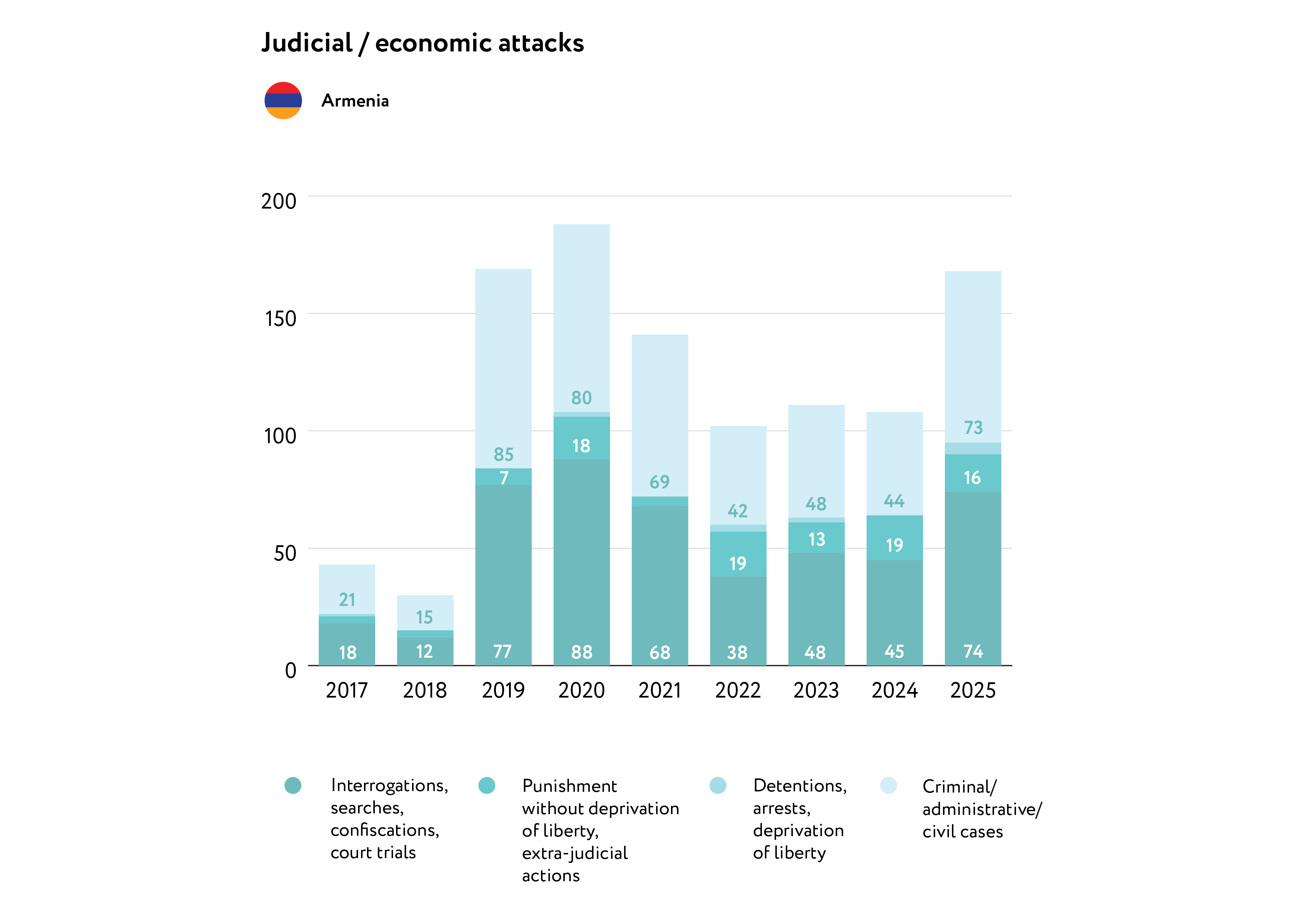
In 74 cases, the allegations related to insults or defamation, while two lawsuits were related to copyright protection. More than half of these cases – 40 out of 76 – were initiated by representatives of the authorities. Examples of such incidents include:
- On 19 February, Speaker of the National Assembly Alen Simonyan filed a lawsuit against Media Hub LLC and journalist Vahe Makaryan, demanding the retraction of information he considers defamatory and USD 2,500 in compensation. He also requested a freeze on the defendants’ assets in the same amount. The case is ongoing.
- On 28 February, Speaker of the National Assembly Alen Simonyan filed a lawsuit against Zhoghovurd Newspaper Editorial LLC, demanding the retraction of information he considers defamatory and more than USD 2,500 in compensation, as well as reimbursement of the state duty. He also requested a freeze on the defendant’s assets in the same amount. The case is ongoing.
- On 4 July, Prime Minister Nikol Pashinyan filed a lawsuit against Hraparak Daily LLC, demanding a retraction of information he considers defamatory, as well as over USD 2,500 in compensation. The case is ongoing.
- On 8 September, Foreign Minister Ararat Mirzoyan filed a lawsuit against Mediahub LLC and journalist Vahe Makaryan, seeking compensation for alleged damage to his honour and dignity. The case is ongoing.
The number of lawsuits filed by non-state actors – opposition figures, clergy, businesspeople, and other individuals and entities – also increased. Examples include:
- On 23 June, six doctors from Yerevan’s NorkMarash Medical Center filed a lawsuit against Social Media LLC, seeking the retraction of Mamul.am videos that accused them of unprofessional conduct and mistreatment allegedly leading to patient deaths, as well as more than USD 7,500 in compensation.
- On 26 June, businessman Narek Nalbandyan filed a lawsuit against the Hayeli Club and its founder Angela Tovmasyan, demanding an apology and a retraction over a Hayeli.am article and video that claimed he was linked to Prime Minister Nikol Pashinyan and Anna Hakobyan, and contained insulting statements. The case remains under review.
- On 14 December, Artur Vanetsyan, leader of the opposition Otechestvo party, filed a lawsuit against Media News LLC, seeking an apology and more than USD 5,000 in compensation over a reposted Facebook comment that mocked him and portrayed him offensively.
The prosecution of the Antifake.am website resulted in the first arrest of media workers in Armenia in many years. Those detained remain in custody at the time of writing this report.
- On 13 November, officers of the National Security Service searched the editorial office of the website Antifake.am, confiscated all equipment used for online broadcasting, and then detained journalist David Fidanian, accusing him of obstructing justice. On 14 November, another staff member, Ishkhan Khosrovyan, was also detained. Khosrovyan was released after several hours, while Fidanian remained in custody for nearly three days. These actions followed two recent episodes of the Imnemnimi podcast, in which hosts Vazghen Sagatelyan and Narek Samsonyan used profanity and threats while criticising senior state officials. Both were detained by the National Security Service on charges of hooliganism and placed under two months of pre-trial detention by court order. The criminal case was initiated based on a report submitted by National Assembly Speaker Alen Simonyan.
ANNEX 1: OPEN SOURCES USED FOR GATHERING DATA (ARMENIA)
- 24news.am – an Armenian multimedia news portal.
- Aravot.am – an Armenian multimedia news portal.
- Armlur.am – an Armenian multimedia news portal.
- Committee to Protect Freedom of Expression – a civic organisation operating in Armenia, engaged in studying the situation in the realm of freedom of speech and publishing periodic reports, as well as defending the rights of journalists and media outlets.
- DataLex.am – the database of Armenia’s judicial system.
- Factor.am – an Armenian multimedia news portal.
- Facebook – pages of political figures, officials and journalists on this social media.
- Freedom House – an international human rights NGO that evaluates and publishes reports on the level of freedom in 210 countries and territories worldwide, including on freedom of speech and media activity.
- Haykakan zhamanak [Armenian Times] – a daily newspaper.
- Hetq.am– the internet publication of the Armenian civic organisation Investigative Journalists.
- Media Initiatives Center – an Armenian NGO, the main mission of which is to create and disseminate free and independent content and by means of this to promote the all-encompassing and harmonious development of society.
- Oragir.news – an Armenian multimedia news portal.
- Radio Azatutyun – the Armenian service of Radio Free Europe/Radio Liberty.
- Region Research Center – an Armenian civic organisation that studies the regional problems of the South Caucasus, including those concerning media activity.
- Reporters Without Borders – an international NGO whose aim is to protect journalists who are being subjected to persecution for doing their job.
- The Committee to Protect Journalists – an international organisation engaged in defending the rights of journalists.
- Yerevan Press Club – an NGO, the principal goal of which is support and development of free, independent, and quality media.